Guide de terrain du photographe d’oiseaux
Les 40 plus beaux oiseaux du Costa Rica
Forêt de nuages, basses terres caribéennes et péninsule d’Osa : comment les quetzals, les trogons et les manakins façonnent un itinéraire de photographie d’oiseaux à travers le Costa Rica.


Le Costa Rica fait tenir un voyage ornithologique sérieux dans un petit pays : la forêt de nuages de la vallée du Savegre et de Monteverde, la forêt tropicale humide et les cours d’eau des basses terres caribéennes, et la péninsule d’Osa avec ses forêts de Corcovado. Cette compacité est à la fois l’attrait et le problème d’organisation. Quetzals, trogons et manakins vivent à des altitudes différentes, dans des lumières différentes et sous des climats différents, si bien que la vraie question n’est pas de savoir s’il faut venir, mais où diriger l’objectif en premier.
Les oiseaux de cette région sont regroupés selon le milieu qu’ils occupent plutôt que selon leur couleur : les espèces de forêt de nuages comme le Quetzal resplendissant, les trogons de forêt humide, les manakins de sous-bois comme le Manakin à longue queue, les toucans et araçaris de canopée, et les colibris en lisière de forêt et dans les clairières. À utiliser comme une liste restreinte pour construire un itinéraire, et non comme un itinéraire routier ; ces régions peuvent être combinées, mais chacune mérite ses propres matinées.
L'essentiel de la photographie d'oiseaux au Costa Rica
- Oiseaux emblématiques : Quetzal resplendissant, Araponga tricaronculé, Ara de Buffon, Colibri à couronne blanche et Cotinga à col nu. Les observations dépendent des habitats et des régions que vous visitez.
- Saison : La saison sèche s’étend de décembre à avril, avec un ensoleillement plus régulier ; de mai à novembre, la période est plus humide, plus verte et plus sujette aux pluies. Renseignez-vous sur les conditions juste avant le départ et emportez de quoi vous protéger de la pluie, quoi qu’il en soit.
- Altitude et terrain : La forêt de nuages est en altitude, fraîche et boueuse ; la forêt tropicale humide de plaine est chaude et humide. Prenez un départ tranquille le premier matin en forêt de nuages, le temps de vous acclimater.
- Accès : La plupart des séjours commencent à l’aéroport Juan Santamaría de San José, avec des trajets routiers, en bus et de courts vols intérieurs vers les différentes régions. On rejoint surtout Tortuguero par bateau ; les règles et les permis du parc évoluant, vérifiez les conditions d’accès actuelles avant de réserver.
- Lumière et moments de la journée : Les oiseaux sont surtout actifs dans les premières heures après l’aube. Construisez chaque journée autour d’un départ matinal, puis utilisez la lumière plus plate de la mi-journée pour les trajets ou la reconnaissance.
- Matériel : Un téléobjectif, des batteries de rechange, une housse de pluie et des chiffons pour objectif priment avant tout. Les trépieds sont souvent peu pratiques sur les sentiers forestiers étroits ; vérifiez donc où ils sont autorisés.
- Éthique : Limitez au strict minimum la repasse et le nourrissage, restez sur les sentiers et laissez de l’espace aux oiseaux nicheurs. Demandez l’autorisation avant de photographier aux mangeoires ou sur des terres privées.
25 place
La carte n’a pas pu être chargée. Les lieux sont indiqués sous chaque oiseau ci-dessous.
L'oiseau le plus beau du Costa Rica N° 1 Toucan à carène
Le Toucan à carène (Ramphastos sulfuratus), souvent surnommé « toucan au bec arc-en-ciel », est une figure emblématique et colorée des forêts tropicales néotropicales qui s’étendent du sud du Mexique à la Colombie. Son trait le plus frappant est son bec surdimensionné en forme de canoë, qui arbore une mosaïque remarquable de vert citron, d’orange vif et de cramoisi ; malgré sa taille imposante, ce bec est étonnamment léger, constitué d’une protéine spongieuse appelée kératine, soutenue par de fines tiges osseuses. Cet oiseau social porte un plumage noir lisse, contrasté par une poitrine et une gorge jaune citron éclatantes, rehaussées par des pattes bleu turquoise et un dessous de queue rouge vif. Au-delà de son apparence saisissante, le Toucan à carène possède des pieds zygodactyles particuliers — avec deux doigts pointant vers l’avant et deux vers l’arrière — qui lui permettent de se déplacer par petits sauts avec habileté dans la canopée, ainsi qu’une habitude de sommeil ingénieuse : il rentre son bec massif sous son aile pour économiser l’espace dans les cavités exiguës des arbres.
- Où observer cet oiseau : Laguna del Lagarto Eco-Lodge – Birdwatching Lodge for photographers, Rancho Naturalista – Birdwatching Lodge, Tapir Valley Nature Reserve, Heliconias Lodge, Celeste Mountain Lodge, Great Green Macaw site near Puerto Viejo, Selva Verde Lodge
Le plus bel oiseau du Costa Rica N° 2 Aracari à collier
L’Aracari à collier est un membre coloré et charismatique de la famille des toucans, immédiatement reconnaissable à ses dessous jaune vif marqués d’une large tache noire sur la poitrine et d’une bande horizontale rouge-noir sur le ventre. Sa caractéristique physique la plus distinctive est son grand bec dentelé, doté de bords uniques en dents de scie qui lui servent à détacher les fruits tropicaux, complété par un collier couleur cannelle, qui lui donne son nom, entourant sa nuque sombre. Avec ses yeux jaunes perçants et son plumage noir luisant, cet oiseau social se déplace souvent en groupes familiaux bruyants dans la canopée des forêts d’Amérique centrale et d’Amérique du Sud. Son comportement le plus fascinant est peut-être son habitude de dormir en communauté : jusqu’à six individus s’entassent dans une même cavité d’arbre, repliant soigneusement leurs longues queues sur leur dos pour gagner de la place, dans une démonstration remarquable de coopération entre oiseaux.
- Où observer cet oiseau : Laguna del Lagarto Eco-Lodge – Birdwatching Lodge for photographers, Rancho Naturalista – Birdwatching Lodge, Guarumo Lodge and La Hoja Garden (Birdwatching Spot), Tapir Valley Nature Reserve, Heliconias Lodge, Celeste Mountain Lodge, Great Green Macaw site near Puerto Viejo, Selva Verde Lodge
L’oiseau le plus beau du Costa Rica N° 3 Tangara à tête rousse
The Bay-headed Tanager (*Tangara gyrola*) is a small, strikingly vibrant songbird that serves as a living jewel of the Neotropical rainforests across Central and South America. Its most defining characteristic is its namesake chestnut-red or "bay" colored head, which creates a sharp, stunning contrast against its brilliant lime-green wings and a belly that ranges from turquoise to deep azure. Many subspecies also feature a thin, golden-yellow collar that further enhances their ornate appearance. Highly social and energetic, these tanagers are often seen flitting acrobatically through the high canopy in mixed-species flocks, where they forage for fruit and small insects. Their dazzling multi-colored plumage and lively presence make them one of the most sought-after sights for birdwatchers exploring the humid tropical woodlands.
- Où observer cet oiseau : Rancho Naturalista – Birdwatching Lodge, Cinchona hummingbird feeders, Puente del Río Rincón, Sendero Botarrama
L’oiseau le plus beau du Costa RicaN° 4Guit-guit saï
The Red-legged Honeycreeper (*Cyanerpes cyaneus*) is a small, dazzling songbird of the tropical Neotropics, renowned for the brilliant, "bubblegum" red legs that give the species its name. The adult male is a visual masterpiece, sporting deep violet-blue plumage contrasted by jet-black wings, a black tail, and a luminous turquoise-aqua crown that seems to glow in the forest canopy. In contrast, females and juveniles are camouflaged in soft olive-green tones with subtle streaking on their underparts. Beyond its electric colors, this bird is distinguished by its long, slender, decurved black bill—a specialized tool perfectly adapted for sipping nectar from a variety of flowers, though it also expertly forages for small fruits and insects. This combination of vivid aesthetics and graceful agility makes it one of the most enchanting and recognizable inhabitants of Central and South American woodlands.
- Où observer cet oiseau : Laguna del Lagarto Eco-Lodge – Birdwatching Lodge for photographers, Guarumo Lodge and La Hoja Garden (Birdwatching Spot), Cerro Lodge, Cinchona hummingbird feeders, Tapir Valley Nature Reserve, Celeste Mountain Lodge, Great Green Macaw site near Puerto Viejo, Puente del Río Rincón, Selva Verde Lodge, Cerro Lodge observation tower, Cerro Lodge access road
Plus bel oiseau du Costa Rica N° 5 Aigle orné
The Ornate Hawk-Eagle (*Spizaetus ornatus*) is a breathtakingly vibrant raptor of the tropical Americas, widely considered one of the most beautiful birds of prey in the world. This medium-to-large eagle is distinguished by its striking "ornate" plumage, featuring a prominent, pointed black crest that it can raise at will, a rich chestnut-colored collar and breast, and bold black-and-white barring across its belly and thighs. Beyond its regal appearance, this forest-dwelling predator is a master of agility, utilizing its broad wings and long, banded tail to navigate dense canopies with high-speed precision. Equipped with formidable yellow talons and piercing golden eyes, it is a powerful hunter capable of taking down prey as large as macaws, toucans, and even small monkeys, cementing its status as a top-tier aerial architect of the rainforest.
- Où observer cet oiseau : Laguna del Lagarto Eco-Lodge – Birdwatching Lodge for photographers, Tapir Valley Nature Reserve, Heliconias Lodge, Celeste Mountain Lodge, Savegre Mountain Hotel, Sendero Botarrama

Le plus bel oiseau du Costa Rica N° 6 Manakin à longue queue
The Long-tailed Manakin (*Chiroxiphia linearis*) is a small, striking bird of the Central American tropical forests, renowned for its extraordinary cooperative courtship rituals. The male is visually arresting, featuring velvety black plumage accented by a brilliant sky-blue back, a vibrant red crown, and two signature ribbon-like tail feathers that can reach up to several times its body length. In stark contrast, the female is a modest olive-green, blending seamlessly into the foliage. What truly sets this species apart is its complex social behavior: two unrelated males—an alpha and a beta—form a long-term partnership to perform highly synchronized "leapfrog" dances and vocal duets on a shared perch to attract a female. Despite this intense teamwork, only the alpha male earns the right to mate, making their coordinated performance one of the most fascinating examples of collaborative display in the natural world.
- Où observer cet oiseau : Heliconias Lodge, Ceibo-Cascajal Road

L’oiseau le plus beau du Costa Rica N° 7 Motmot à sourcils turquoises
The Turquoise-browed Motmot (*Eumomota superciliosa*) is a strikingly beautiful bird native to Central America, instantly recognizable by its vibrant palette of olive-green plumage, a rufous back and belly, and the brilliant turquoise stripes above its eyes that give the species its name. Its most extraordinary feature is its long, elegant tail, which terminates in two distinct "rackets"—feathered tips at the end of long, bare shafts created when the bird preens away the fragile middle barbs. Beyond its aesthetics, this motmot is famous for its unique "pendulum" behavior, where it swings its tail from side to side like a clock to signal to potential predators that they have been spotted, a clever survival tactic that discourages pursuit. As the national bird of both El Salvador and Nicaragua, this charismatic species is as culturally significant as it is biologically fascinating, often found nesting in deep tunnels bored into earth banks or limestone crevices.
- Où observer cet oiseau : Cerro Lodge, Tarcoles River boat trip, Cerro Lodge observation tower, Cerro Lodge access road, Humedales de San Joaquín, Ceibo-Cascajal Road, Refugio de Vida Silvestre La Ensenada

Oiseau le plus beau du Costa Rica N° 8 Quetzal resplendissant
- Où observer cet oiseau : Paraiso Quetzal Lodge and finca, Savegre Mountain Hotel, Savegre Mountain Hotel private reserve

Le plus bel oiseau du Costa Rica N° 9 Cotinga céleste
The Lovely Cotinga (*Cotinga amabilis*) is a dazzling jewel of Central American rainforests, renowned for its breathtaking, almost surreal coloration. The male is a vision of electric turquoise and vibrant blue, with a striking deep purple throat and chest, while the female is a more subdued, scaly brown for camouflage. This bird’s most unique characteristic is its iridescent feathers, which lack blue pigment; instead, they refract light through microscopic structures to produce its brilliant, shimmering hues. A special feature is its quiet, whistling call, often heard before the bird is seen, and its frugivorous diet, which helps disperse seeds throughout its canopy home. Despite its name, the Lovely Cotinga is rarely observed due to its elusive, high-canopy lifestyle, making each sighting a memorable event for birdwatchers.
- Où observer cet oiseau : Rancho Naturalista – Birdwatching Lodge, Tapir Valley Nature Reserve

Le plus bel oiseau du Costa Rica N° 10 Tangara à capuchon doré
The Golden-hooded Tanager (*Stilpnia larvata*) is a dazzling jewel of Central and South American forests, instantly recognizable by its vibrant, turquoise-blue body contrasted with a brilliant golden-yellow hood that covers its head and throat. A striking black mask around the eyes and a pale, silvery-blue bill add to its unique, almost theatrical appearance. Unlike many tanagers, it often forages in mixed-species flocks, flitting actively through the canopy to feast on fruit and insects. A special feature is its subtle iridescence: the blue feathers can shift to a deep, metallic green in certain lights, making this small, energetic bird a living prism of the rainforest.
- Où observer cet oiseau : Laguna del Lagarto Eco-Lodge – Birdwatching Lodge for photographers, Rancho Naturalista – Birdwatching Lodge, Guarumo Lodge and La Hoja Garden (Birdwatching Spot), Tapir Valley Nature Reserve, Celeste Mountain Lodge, Great Green Macaw site near Puerto Viejo, Puente del Río Rincón

L’oiseau le plus beau du Costa Rica N° 11 Passerin nonpareil
The painted bunting (*Passerina ciris*) is one of North America’s most brilliantly colored songbirds, often called the "nonpareil" (French for "without equal") for its unmatched plumage. The male is a living mosaic of vivid colors: a deep blue head, bright green back, and a fiery red-orange breast and rump, while the female and juveniles are a subtle, lime-green above and pale yellow below, providing excellent camouflage. A unique characteristic is its secretive, skulking behavior—despite its flashy appearance, it prefers to stay hidden in dense thickets and brushy edges, singing a sweet, warbling song from cover. Special features include a thick, conical beak perfectly adapted for cracking seeds, and its remarkable migratory journey from the southeastern United States to wintering grounds in Central America and the Caribbean, where it sometimes flocks with other buntings in coastal scrub. This species is a dazzling gem for birdwatchers, blending extreme beauty with a shy, elusive nature.
- Où observer cet oiseau : Tarcoles River boat trip, Cerro Lodge access road, Ceibo-Cascajal Road

Plus bel oiseau du Costa Rica N° 12 Moucherolle royal tropical
The Tropical Royal Flycatcher (*Onychorhynchus coronatus*) is a small, unassuming passerine bird of the Neotropics that hides one of the avian world's most spectacular surprises. Generally, it appears as a warm brown bird with a buffy throat and a bold, cinnamon-rufous tail, but its true glory is a massive, fan-shaped crest that, when raised, reveals a brilliant fan of scarlet or orange feathers tipped with iridescent blue-black spots. This crest is used primarily in courtship displays and rarely seen otherwise, making sightings a prized event. A special feature is its unique nest—a long, hanging pouch of plant fibers and spiderwebs that dangles from a branch over water, protecting its young from predators. Despite its regal name, the flycatcher is a master of stealth, sallying out from perches to snatch insects mid-air, its dazzling crown a fleeting, jewel-like secret of the rainforest.
- Où observer cet oiseau : Laguna del Lagarto Eco-Lodge – Birdwatching Lodge for photographers, Tapir Valley Nature Reserve, Ceibo-Cascajal Road

Le plus bel oiseau du Costa Rica N° 13 Colibri à gorge rubis
The Ruby-throated Hummingbird (*Archilochus colubris*) is a dazzling jewel of eastern North America, renowned as the only hummingbird species that breeds east of the Mississippi River. Males are unmistakable, with a brilliant, iridescent ruby-red throat that flashes like a beacon against their metallic emerald-green back and white underparts, while females and juveniles lack the red gorget, sporting a clean white throat and subtle speckling. A master of agile flight, this tiny bird beats its wings up to 80 times per second, allowing it to hover mid-air, fly backwards, and even upside down as it sips nectar from tubular flowers with its specialized, extendable tongue. Perhaps its most astonishing special feature is its epic annual migration: weighing barely a nickel, it undertakes a non-stop 500-mile journey across the Gulf of Mexico twice a year, a feat of endurance that cements its status as one of nature’s most remarkable aviators.
- Où observer cet oiseau : Rancho Naturalista – Birdwatching Lodge, Guarumo Lodge and La Hoja Garden (Birdwatching Spot), Cerro Lodge, Tapir Valley Nature Reserve, Heliconias Lodge, Cerro Lodge observation tower, Cerro Lodge access road, Humedales de San Joaquín, Ceibo-Cascajal Road, Sendero Botarrama, Refugio de Vida Silvestre La Ensenada

L'oiseau le plus beau du Costa Rica N° 14 Jabiru d'Amérique
Le Jabiru (*Jabiru mycteria*) est une cigogne imposante et majestueuse originaire des zones humides d’Amérique centrale et d’Amérique du Sud, immédiatement reconnaissable comme l’un des plus grands oiseaux volants de la région. Pouvant atteindre un mètre cinquante de haut, avec une envergure massive dépassant deux mètres quarante, son trait le plus frappant est son plumage d’un blanc pur contrastant avec une tête et un cou nus et noirs, ornés à la base d’une tache gulaire rouge vif. Unique parmi les cigognes, le Jabiru possède un bec noir puissant légèrement relevé, qu’il utilise pour harponner avec habileté des poissons, des grenouilles et des reptiles dans les eaux peu profondes. Son nom, qui signifie « cou gonflé » en tupi-guarani, décrit parfaitement la poche gulaire distinctive et gonflable de l’oiseau, dont il se sert pour communiquer et pour ses parades nuptiales, ce qui donne à cet oiseau à l’allure ancestrale une présence remarquable dans les vastes ciels du Pantanal.
- Où observer cet oiseau : Laguna de Los Chiles

L’oiseau le plus beau du Costa Rica N° 15 Jacobin à col blanc
The White-necked Jacobin (*Florisuga mellivora*) is a dazzling hummingbird found from southern Mexico to the Amazon basin, renowned for its striking iridescent plumage and unique, almost scaly-looking throat. The male is particularly eye-catching, with a brilliant white belly and a broad, white crescent on the nape that contrasts sharply with its deep, metallic blue head and chest, while the back and tail shimmer with emerald and turquoise hues. A special feature is its relatively large, forked tail, which it fans out during display, and unlike many hummingbirds, the male lacks a colorful gorget, instead showcasing a smooth, glossy blue bib. Females and juveniles are more cryptic, with green upperparts and white-spotted underparts, but share the species’ characteristic rapid, bee-like flight and a loud, chattering call that echoes through the forest canopy.
- Où observer cet oiseau : Laguna del Lagarto Eco-Lodge – Birdwatching Lodge for photographers, Rancho Naturalista – Birdwatching Lodge, Guarumo Lodge and La Hoja Garden (Birdwatching Spot), Tapir Valley Nature Reserve, Heliconias Lodge, Puente del Río Rincón, Selva Verde Lodge, Sendero Botarrama

Le plus bel oiseau du Costa Rica N° 16 Coquette à crête noire
The Black-crested Coquette (*Lophornis helenae*) is a dazzling gem of a hummingbird, barely larger than a bumblebee, found in the humid forests of Central America. Its most striking feature is the male’s iridescent, jet-black crest that flares dramatically backward, contrasting with a fiery coppery-orange throat and a vivid white band across the rump. The female lacks the crest but shares a shimmering green back and a cinnamon belly, while both sexes sport a distinctive, bright white stripe down the center of the tail. A special highlight is the male’s glittering, emerald-green gorget that catches the light like a jewel, making this tiny bird an unforgettable flash of color in the understory.
- Où observer cet oiseau : Rancho Naturalista – Birdwatching Lodge, Guarumo Lodge and La Hoja Garden (Birdwatching Spot), Tapir Valley Nature Reserve, Heliconias Lodge, Celeste Mountain Lodge, Great Green Macaw site near Puerto Viejo, Selva Verde Lodge, Sendero Botarrama

L'oiseau le plus beau du Costa Rica N° 17 Paruline à ailes dorées
The Golden-winged Warbler (*Vermivora chrysoptera*) is a strikingly beautiful songbird of North American shrublands, instantly recognizable by its bold black-and-white facial pattern and brilliant, sun-yellow patches on its crown and wings. A true gem of early successional habitats, this small warbler has a gray body and white underparts, with the males sporting a distinctive black throat and mask that contrasts sharply with their golden highlights. One of its most unique characteristics is its frequent hybridization with the closely related Blue-winged Warbler, producing rare and distinctive hybrids like the "Brewster's" and "Lawrence's" warblers, a phenomenon that fascinates ornithologists. Special features include its buzzy, insect-like song and its specialized foraging behavior, where it gleans insects from the undersides of leaves and occasionally hovers to catch prey. Sadly, this species is in steep decline due to habitat loss and competition from its hybridizing cousin, making its conservation a priority for bird enthusiasts across the eastern United States and its wintering grounds in Central and South America.
- Où observer cet oiseau : Rancho Naturalista – Birdwatching Lodge, Tapir Valley Nature Reserve, Heliconias Lodge, Celeste Mountain Lodge, Savegre Mountain Hotel, Sendero Botarrama

L'oiseau le plus beau du Costa Rica N° 18 Toucan à gorge jaune
The Yellow-throated Toucan (*Ramphastos ambiguus*) is a striking avian giant of Central and South American rainforests, instantly recognizable by its enormous, colorful bill—a lightweight marvel of keratin that can reach one-third of its body length. Its plumage is predominantly glossy black, dramatically offset by a vivid yellow throat and chest, a white rump, and a red undertail, while the bill itself is a masterpiece of green, yellow, orange, and red hues with a distinct black tip. Unlike many birds, this toucan possesses a unique, serrated bill edge used for plucking fruit and occasionally raiding nests, and it relies on a specialized tongue fringed with bristles to manipulate food. As a keystone species, it plays a vital ecological role by dispersing large seeds across the forest, while its raucous, frog-like call echoes through the canopy, making it both a visual and auditory icon of its tropical home.
- Où observer cet oiseau : Laguna del Lagarto Eco-Lodge – Birdwatching Lodge for photographers, Rancho Naturalista – Birdwatching Lodge, Guarumo Lodge and La Hoja Garden (Birdwatching Spot), Tapir Valley Nature Reserve, Heliconias Lodge, Celeste Mountain Lodge, Great Green Macaw site near Puerto Viejo, Puente del Río Rincón, Selva Verde Lodge, Headquarters Trail, Sendero Botarrama

Plus bel oiseau du Costa Rica N° 19 Coquette à queue fine
Discosura conversii
- Où observer cet oiseau : Rancho Naturalista – Birdwatching Lodge, Cinchona hummingbird feeders, Tapir Valley Nature Reserve, Sendero Botarrama

Le plus bel oiseau du Costa Rica N° 20 Cabézon à tête rouge
- Où observer cet oiseau : Cinchona hummingbird feeders, Savegre Mountain Hotel, Sendero Botarrama

L’oiseau le plus beau du Costa Rica N° 21 Céphaloptère à cou nu
- Où observer cet oiseau : Tapir Valley Nature Reserve, Heliconias Lodge, Celeste Mountain Lodge
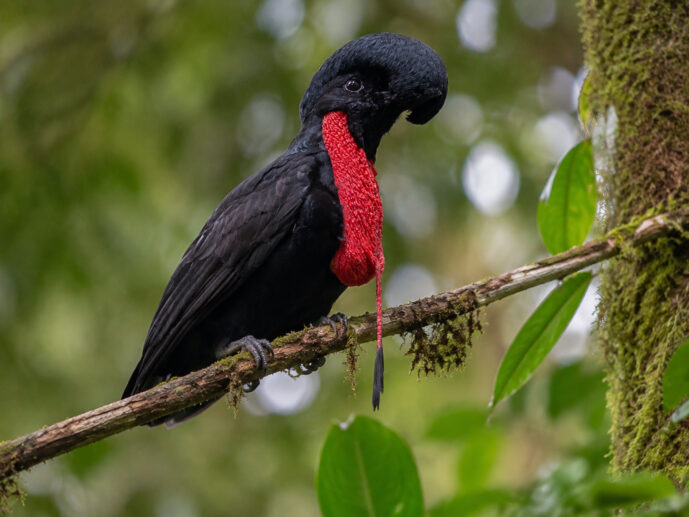
L’oiseau le plus beau du Costa Rica N° 22 Coquette adorable
- Où observer cet oiseau : Rancho Naturalista – Birdwatching Lodge

Le plus bel oiseau du Costa Rica N° 23 Chouette à lunettes
The Spectacled Owl (*Pulsatrix perspicillata*) is a striking nocturnal predator native to the dense rainforests of Central and South America, instantly recognizable by the "spectacles" of white feathers that frame its piercing yellow eyes. This large owl features a deep chocolate-brown head and back contrasted by a creamy-buff underbelly, creating a regal and imposing silhouette within the tropical canopy. While adults are masters of camouflage, their juveniles possess a unique and ghostly appearance, covered in fluffy white down with a startling black heart-shaped facial mask. Renowned for its deep, rhythmic hooting that sounds like a distant hammer striking a hollow log, the Spectacled Owl is a formidable hunter, capable of swooping down with silent precision to claim prey as large as opossums and small monkeys.
- Où observer cet oiseau : Laguna del Lagarto Eco-Lodge – Birdwatching Lodge for photographers, Cerro Lodge, Tapir Valley Nature Reserve, Cerro Lodge observation tower, Cerro Lodge access road, Humedales de San Joaquín, Headquarters Trail, Caldera mangroves

Le plus bel oiseau du Costa Rica N° 24 Sarcoramphe roi
The King Vulture (*Sarcoramphus papa*) is a strikingly regal scavenger that stands out as one of the most colorful birds of prey in the tropical forests of Central and South America. While most vultures possess somber plumage, the King Vulture boasts a creamy white body contrasted by dark grey flight feathers and a thick, velvety neck ruff. Its most arresting feature is its featherless head and neck, which display a vivid kaleidoscope of orange, yellow, red, and purple skin, topped with a distinctive, fleshy orange caruncle above its powerful hooked beak. True to its name, this large raptor dominates the scavenging hierarchy; its superior size and immense beak strength allow it to tear through tough hides that smaller vultures cannot, granting it "royal" priority at every carcass it discovers.
- Où observer cet oiseau : Laguna del Lagarto Eco-Lodge – Birdwatching Lodge for photographers, Rancho Naturalista – Birdwatching Lodge, Tapir Valley Nature Reserve, Great Green Macaw site near Puerto Viejo, Puente del Río Rincón, Selva Verde Lodge, Headquarters Trail, Sendero Botarrama

Oiseau le plus beau du Costa Rica N° 25 Chevêchette brune
Standing barely seven inches tall, the Ferruginous Pygmy-Owl (*Glaucidium brasilianum*) is a pint-sized powerhouse known for its bold personality and striking appearance. This sparrow-sized raptor features a round, tuftless head with piercing yellow eyes and prominent white "eyebrows" that give it a perpetually stern expression. While its plumage varies from a rich reddish-brown to a streaky gray, its most remarkable adaptation is a pair of black "false eyes" (ocelli) on the back of its neck, designed to deceive predators and pestering songbirds into thinking they are being watched from behind. Unlike many of its nocturnal relatives, this diurnal hunter is active during the day, frequently seen cocking its relatively long tail while perched in lowland thickets, where it fearlessly pursues prey often twice its own size.
- Où observer cet oiseau : Cerro Lodge, Tarcoles River boat trip, Cerro Lodge observation tower, Cerro Lodge access road, Humedales de San Joaquín, Ceibo-Cascajal Road, Headquarters Trail

Plus bel oiseau du Costa Rica N° 26 Trogon pattu
The Gartered Trogon (*Trogon caligatus*) is a vibrant jewel of the Neotropical canopy, celebrated for its striking coloration and stoic presence. Males are particularly eye-catching, featuring a deep violet-blue head and breast that gives way to a brilliant yellow belly, all framed by a shimmering metallic green back and intricately barred black-and-white undertail feathers. Its most distinctive physical trait is the vivid yellow eye-ring, or "garter," which encircles its dark eyes and provides a sharp contrast to its dark face. Beyond its beauty, this species possesses a remarkable nesting strategy: it often excavates its home within active wasp or termite mounds, utilizing the stinging or biting insects as a built-in security system against predators. Whether sitting perfectly still on a shaded branch or performing acrobatic maneuvers to pluck fruit and insects, the Gartered Trogon remains one of the most charismatic and resourceful inhabitants of the tropical forest.
- Où observer cet oiseau : Rancho Naturalista – Birdwatching Lodge, Cerro Lodge, Tapir Valley Nature Reserve, Heliconias Lodge, Great Green Macaw site near Puerto Viejo, Puente del Río Rincón, Cerro Lodge observation tower, Cerro Lodge access road, Ceibo-Cascajal Road, Sendero Botarrama, Refugio de Vida Silvestre La Ensenada

Plus bel oiseau du Costa Rica N° 27 Batara rayé
The Barred Antshrike (*Thamnophilus doliatus*) is a striking Neotropical bird instantly recognizable by its bold, zebra-like plumage and expressive, erectile crest. This species exhibits dramatic sexual dimorphism: while the male is covered in high-contrast black and white horizontal bars, the female sports a warm, cinnamon-rufous coat with delicate black streaking on her head. A defining physical feature is its heavy, hooked bill—perfectly adapted for snatching insects and small vertebrates—complemented by piercing, pale-yellow eyes that give it a fierce expression. Renowned for its rhythmic, accelerating song that often echoes through forest edges and scrublands, the Barred Antshrike is as charismatic as it is visual, frequently puffing out its crown feathers to signal its presence or defend its territory.
- Où observer cet oiseau : Cerro Lodge, La Selva Biological Station, Tapir Valley Nature Reserve, Celeste Mountain Lodge, Tarcoles River boat trip, Great Green Macaw site near Puerto Viejo, Cerro Lodge observation tower, Cerro Lodge access road, Refugio de Vida Silvestre La Ensenada

Le plus bel oiseau du Costa Rica N° 28 Troglodyte roux et blanc
The Rufous-and-white Wren (*Thryophilus rufalbus*) is a striking songbird of the Neotropics, easily recognized by its vibrant chestnut-red upperparts and contrasting, snowy-white underparts. Native to the dry forests and scrublands of Central and South America, this medium-sized wren features a bold white "eyebrow" stripe and intricate black-and-white barring on its wings and tail. While its plumage is visually sharp, its most enchanting feature is its liquid, flute-like song; these birds are masters of complex vocalizations, often engaging in sophisticated "antiphonal duetting" where mated pairs synchronize their melodies so perfectly they sound like a single individual. Secretive yet spirited, the Rufous-and-white Wren is a true gem of the forest undergrowth, combining architectural skill in building its flask-shaped nests with one of the most melodic and hauntingly beautiful voices in the avian world.
- Où observer cet oiseau : Cerro Lodge access road

Le plus bel oiseau du Costa Rica N° 29 Piranga écarlate
The Scarlet Tanager (*Piranga olivacea*) is a breathtaking songbird of the eastern North American forests, most famous for the male’s stunning breeding plumage of brilliant crimson offset by jet-black wings and a coal-black tail. Despite their fiery appearance, these birds are often elusive "forest ghosts," spending much of their time foraging high within the dense deciduous canopy for insects and fruit. A fascinating master of transformation, the male molts his red feathers for a cryptic olive-yellow coat in the winter, matching the year-round appearance of the female. Renowned for a unique, "burry" song that sounds like a robin with a sore throat, the Scarlet Tanager is also a remarkable long-distance traveler, migrating thousands of miles each year to spend the winter in the lush Amazon basin of South America.
- Où observer cet oiseau : Laguna del Lagarto Eco-Lodge – Birdwatching Lodge for photographers, Rancho Naturalista – Birdwatching Lodge, Tapir Valley Nature Reserve, Heliconias Lodge, Celeste Mountain Lodge

L’oiseau le plus beau du Costa Rica N° 30 Tangara à cou bleu
The Blue-necked Tanager (*Stilpnia cyanicollis*) is a small, spectacularly colored songbird native to the humid forests and woodland edges of South America. It is most renowned for its namesake feature: a brilliant, iridescent turquoise-blue head and neck that contrasts sharply against its velvety black underparts and back. Adding to its jewel-like appearance are its striking wings, which feature shimmering patches of golden-yellow or straw-colored feathers on the shoulders. These social birds are high-energy foragers, often seen flitting through the canopy in mixed-species flocks as they search for a diet of berries, seeds, and small insects. With its radiant plumage and high-pitched, metallic chirps, the Blue-necked Tanager serves as a vibrant and captivating gem of the tropical landscape.
- Où observer cet oiseau : La Selva Biological Station

Le plus bel oiseau du Costa Rica N° 31 Ara rouge
The Scarlet Macaw (*Ara macao*) is a breathtaking neotropical parrot renowned for its vibrant explosion of color, featuring a brilliant red body accented by bold yellow wing coverts and deep blue flight feathers. Native to the humid rainforests of Central and South America, this large bird is easily identified by its long, pointed tail and powerful, hooked beak, which it uses with incredible dexterity to crack hard nuts and seeds. Beyond its striking appearance, the Scarlet Macaw is highly intelligent and social, often seen flying in pairs or small flocks while emitting raucous calls that echo through the canopy. Among its most fascinating traits are its zygodactyl feet—with two toes facing forward and two backward—which allow it to climb and manipulate food with the precision of a hand, and its habit of visiting riverbank clay licks to neutralize toxins in its diet, making it a true icon of tropical biodiversity.
- Où observer cet oiseau : Laguna del Lagarto Eco-Lodge – Birdwatching Lodge for photographers, Cerro Lodge, Tarcoles River boat trip, Great Green Macaw site near Puerto Viejo, Puente del Río Rincón, Selva Verde Lodge, Cerro Lodge observation tower, Cerro Lodge access road, Ceibo-Cascajal Road

Le plus bel oiseau du Costa Rica N° 32 Conure à yeux blancs
The White-eyed Parakeet (*Psittacara leucophthalmus*) is a vibrant and highly adaptable neotropical parrot native to the forests and urban landscapes of South America. Primarily cloaked in a lush emerald-green plumage, this medium-sized bird is most distinguished by the prominent patch of bare, creamy-white skin encircling its eyes, which provides a striking contrast to its dark irises and horn-colored beak. While it may appear uniform at rest, the parakeet reveals hidden splendor during flight, showcasing brilliant flashes of red and yellow feathers on its underwing coverts and the bend of the wing. Renowned for their intelligence, social nature, and impressive vocal mimicry, these resilient birds are often seen in boisterous flocks, making them one of the most charismatic and widespread members of the *Psittacara* genus.
- Où observer cet oiseau : La Selva Biological Station

L’oiseau le plus beau du Costa Rica N° 33 Motmot nain
The Tody Motmot (*Hylomanes momotula*) is a captivating avian gem, distinguished as the smallest member of the motmot family. Measuring only about 17 centimeters, this neotropical forest dweller sports a vibrant emerald-green body complemented by a rich cinnamon crown and a sharp black mask that streaks through its eyes. Unlike its larger relatives, the Tody Motmot is unique because it lacks the iconic racket-shaped tail feathers, possessing instead a short, square tail that contributes to its compact, tody-like silhouette. It is further identified by a subtle white stripe below its eye and a small tuft of black feathers centered on its chest. Known for its "sit-and-wait" hunting strategy, this elusive bird often remains perfectly still on low branches before darting out to snatch insects, making it a prized and charming sight within the dense undergrowth of Central and South America.
- Où observer cet oiseau : Tapir Valley Nature Reserve, Heliconias Lodge, Celeste Mountain Lodge

Plus bel oiseau du Costa Rica N° 34 Oriole à poitrine tachetée
The Spot-breasted Oriole (*Icterus pectoralis*) is a vibrant and striking songbird primarily native to the Pacific slope of Central America, though it has famously established a naturalized population in the suburban gardens of southern Florida. Draped in a brilliant, fiery orange plumage that contrasts sharply with its jet-black wings, tail, and throat bib, this oriole is most distinguished by the unique cluster of black spots decorating the sides of its chest—a namesake feature that sets it apart from its relatives. Remarkably, unlike many other oriole species where females are often duller, both sexes of the Spot-breasted Oriole boast this same dazzling, high-contrast appearance. Beyond its tropical beauty, the bird is celebrated for its rich, flute-like whistles and its impressive ability to weave long, pendulous nests that sway from the tips of tree branches, making it both a visual and auditory treasure of the avian world.
- Où observer cet oiseau : Ceibo-Cascajal Road, Refugio de Vida Silvestre La Ensenada

Le plus bel oiseau du Costa Rica N° 35 Organiste à gorge jaune
- Où observer cet oiseau : Rancho Naturalista – Birdwatching Lodge, Guarumo Lodge and La Hoja Garden (Birdwatching Spot), Tapir Valley Nature Reserve, Heliconias Lodge, Celeste Mountain Lodge, Great Green Macaw site near Puerto Viejo, Selva Verde Lodge
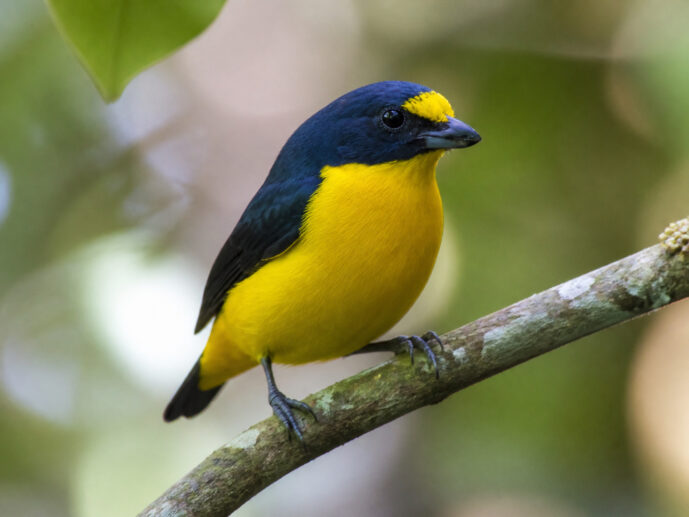
Le plus bel oiseau du Costa Rica N° 36 Geai à gorge blanche
- Où observer cet oiseau : Cerro Lodge, Heliconias Lodge, Cerro Lodge observation tower, Cerro Lodge access road, Ceibo-Cascajal Road, Refugio de Vida Silvestre La Ensenada

Oiseau le plus beau du Costa Rica N° 37 Euphonia élégante
- Où observer cet oiseau : Savegre Mountain Hotel

L'oiseau le plus beau du Costa Rica N° 38 Trogon de Masséna
- Où observer cet oiseau : Laguna del Lagarto Eco-Lodge – Birdwatching Lodge for photographers, Heliconias Lodge, Celeste Mountain Lodge, Puente del Río Rincón, Headquarters Trail

Le plus bel oiseau du Costa Rica N° 39 Tangara à ailes blanches
- Où observer cet oiseau : Savegre Mountain Hotel

Plus bel oiseau du Costa Rica N° 40 Passerin indigo
- Où observer cet oiseau : Ceibo-Cascajal Road

À retenir
- Répartissez le séjour par étage d’altitude : prévoyez une base en forêt de nuages et une autre en forêt tropicale de plaine, plutôt que de faire la navette entre les deux pour quelques matinées isolées.
- Structurez l’itinéraire autour des matins à quetzal et à trogon : consacrez les premières lueurs du jour, sur quelques jours, à la forêt de nuages, et laissez les espèces des basses terres et des zones humides occuper le reste.
- Gardez une journée de marge : lorsque la pluie ou la brume annule une matinée, cette journée de réserve protège les séances autour desquelles le voyage a été conçu.
Le Costa Rica justifie le voyage parce qu’un seul itinéraire peut couvrir plusieurs habitats : la forêt de nuages pour le Quetzal resplendissant et les trogons, la forêt tropicale de plaine pour les toucans, les aracaris et les manakins, ainsi que les lisières et les clairières pour les colibris et les tyrans. Les décisions qui comptent se prennent avant de réserver : quel étage altitudinal recevra vos meilleures matinées, si Tortuguero ou Corcovado mérite son propre bloc de jours, et quelle part d’aléas météo vous êtes prêt à intégrer.
Si vous préférez déléguer la logistique, le Voyage Photo au Costa Rica : les meilleurs sites d’observation des oiseaux, de Carara à Sarapiqui suit un itinéraire ornithologique de Carara à Sarapiqui et place la photographie au centre de la journée.
Questions fréquentes
Parmi les oiseaux remarquables à observer au Costa Rica, cinq se distinguent : le quetzal resplendissant, l’araponga tricaronculé, l’ara de Buffon, la coquette blanche et le cotinga à cou nu. La forêt de nuages abrite le quetzal et l’araponga, tandis que les forêts de piémont et de plaine accueillent la minuscule coquette blanche, l’ara spectaculaire et le cotinga insaisissable.
Il s’agit de cibles spécialisées plutôt que d’observations garanties ; le meilleur choix dépend de votre itinéraire, de la saison et des habitats que vous visitez.
Pas nécessairement. Nous faisons généralement appel à des chauffeurs privés pour nos circuits, ce qui vous permet de profiter du trajet sans avoir à vous orienter sur des routes inconnues. Pour un trajet plus lent ou si vous tenez davantage à votre indépendance, nous pouvons plutôt vous proposer de louer un véhicule. Selon l’itinéraire, cette option peut aussi être plus économique. Nous discuterons des alternatives avec vous lors de la planification de votre itinéraire.
Le prix dépend de l'itinéraire, de la durée, de l'hébergement, du transport, des activités et du nombre de voyageurs. La proposition doit préciser ce qui est inclus et exclu.
Le climat du Costa Rica varie selon la région et l’altitude. La côte Pacifique connaît une saison sèche plus marquée, généralement de décembre à mars, tandis que les zones côtières des Caraïbes ont souvent des périodes relativement plus sèches en février–mars et en septembre–octobre. Il s’agit de tendances générales : vos centres d’intérêt, votre itinéraire et votre tolérance à la pluie comptent donc dans le choix des dates.
Cela dépend des régions que vous choisissez et de la fréquence à laquelle vous souhaitez changer d’hébergement. Nous pouvons vous aider à mettre en balance le nombre d’étapes et le temps disponible.
Continuez à explorer
Voyage Photo au Costa Rica : les meilleurs sites d’observation des oiseaux, de Carara à Sarapiqui
Un circuit ornithologique de neuf jours au Costa Rica, au rythme tranquille, de la forêt sèche du Pacifique et de Carara aux hauts plateaux de Talamanca, aux contreforts des Caraïbes, à La Selva et à Cinchona.

Costa Rica pour les photographes : guide de destination photographique
Le Costa Rica est un paradis pour les photographes grâce à ses paysages à couper le souffle, à sa faune et à ses plages immaculées.
Voyage Photo au Costa Rica
Découvrez les paysages époustouflants et la faune vibrante lors de notre voyage photo au Costa Rica. Immortalisez des souvenirs inoubliables !
Voyage Photo ornithologique au Costa Rica : quetzal et colibris
Un voyage de 13 jours en petit groupe, consacré à l’observation des oiseaux et à la photographie, à travers les habitats emblématiques du Costa Rica, du pays des quetzals des hauts plateaux de Talamanca aux forêts nuageuses de Monteverde et aux basses terres riches en perroquets…

Costa Rica hors des sentiers battus : faune, forêt de nuages et volcans
Un voyage de 22 jours à travers le Costa Rica, mêlant immersion culturelle et observation de la faune, de Sarapiquí et du Río Sarapiquí à Tortuguero, Boca Tapada, La Fortuna, Bijagua, Monteverde, Dominical et Manuel Antonio, avec des bases où passer la nuit…

Oiseaux de Colombie
Un guide pratique pour photographier les colibris, les tangaras et les oiseaux endémiques de Colombie dans les Andes, la sierra Nevada de Santa Marta et le Chocó, avec des conseils selon les saisons.

Observation des oiseaux au Costa Rica : de la forêt de nuages aux basses terres caribéennes
Des quetzals de la forêt de nuages aux toucans des basses terres caraïbes, un voyage à la découverte de la riche diversité ornithologique du Costa Rica.

Birds of Brazil
Des zones humides du Pantanal en saison sèche aux sentiers de la forêt atlantique et aux toucans dans la canopée : comment répartir un voyage de photographie ornithologique au Brésil selon les régions et les saisons.

Birds of Peru
Guide du photographe d’oiseaux pour les oiseaux remarquables du Pérou, de la forêt sèche du Marañón à la route du Manu et aux basses terres amazoniennes, avec des conseils sur la période de saison sèche et l’altitude.

Birds of Ecuador
Un guide de terrain pour photographier les oiseaux d’Équateur selon les régions et les saisons, des mangeoires à colibris des hautes Andes et des condors du páramo à la forêt de nuages du Chocó et aux basses terres amazoniennes.

Birds of Panama
Toucans et tangaras dans les basses terres de Soberanía, motmots et manakins en lisière de forêt, et spécialités de la forêt de nuages autour de Boquete : une présélection fondée sur les habitats pour les photographes au Panama.

Birds of Bolivia
La Bolivie réunit la puna, la forêt de nuages des Yungas et les basses terres amazoniennes le long d’un même gradient altitudinal. Un guide axé sur les itinéraires pour découvrir les oiseaux, les habitats et les périodes propices du pays.

Photographie animalière
Capturez l'essence de la nature : découvrez les secrets d'une photographie animalière époustouflante.

Colibris du Brésil

Most beautiful Birds in Guatemala

Parcs nationaux
Découvrez les paysages époustouflants du Costa Rica, d'Arenal à Corcovado, dans notre guide des parcs.

Plages
Découvrez les plus belles plages du Costa Rica pour une escapade inoubliable sous le soleil.

Pourquoi le Costa Rica ?
Explorez la biodiversité du Costa Rica, ses lieux d'aventure et son mode de vie pura vida !

Randonnées
Explorez les meilleurs sentiers du Costa Rica, des panoramas d'Arenal à la faune du Corcovado.

Que faire ?
Découvrez les meilleures activités du Costa Rica : des sources d'eau chaude d'Arenal aux forêts de nuages de Monteverde.