A bird photographer's field guide
40 Most beautiful birds in Costa Rica
Cloud forest, the Caribbean lowlands and the Osa peninsula: how quetzals, trogons and manakins shape a bird photography route through Costa Rica.


Costa Rica fits a serious bird trip into a small country: cloud forest in the Savegre valley and at Monteverde, the rainforest and waterways of the Caribbean lowlands, and the Osa peninsula with its Corcovado forests. That compactness is the appeal and the planning problem. Quetzals, trogons and manakins live at different heights, in different light and in different weather, so the real question is not whether to come but where to point the lens first.
The birds here are grouped by the ground they hold rather than by colour: cloud-forest species such as the Resplendent Quetzal, trogons of humid forest, understory manakins like the Long-tailed Manakin, canopy toucans and aracaris, and hummingbirds along forest edges and clearings. Use it as a shortlist to build a route around, not a driving itinerary; these regions can be combined, but each deserves its own mornings.
Costa Rica bird photography essentials
- Iconic birds: Resplendent Quetzal, Three-wattled Bellbird, Great Green Macaw, Snowcap and Bare-necked Umbrellabird. Sightings depend on the habitats and regions you visit.
- Season: The dry season runs from December to April, with more reliable sun; May to November is wetter, greener and rain-prone. Check conditions close to departure and carry rain protection either way.
- Altitude and terrain: Cloud forest is high, cool and muddy; lowland rainforest is hot and humid. Give the first cloud-forest morning a slow start while you adjust.
- Access: Most trips begin at Juan Santamaría airport in San José, with road, bus and short domestic flights to the regions. Tortuguero is reached mainly by boat, and park rules and permits change, so confirm current access before booking.
- Light and timing: Birds are most active in the first hours after dawn. Build each day around an early start, then use the flatter midday light for travel or scouting.
- Gear: A long lens, spare batteries, rain cover and lens cloths matter most. Tripods are often impractical on narrow forest trails, so check where they are allowed.
- Ethics: Keep playback and feeding to a minimum, stay on trails and give nesting birds room. Ask before photographing at feeders or on private land.
Most beautiful bird in Costa Rica N° 1 Keel-billed Toucan
The Keel-billed Toucan (*Ramphastos sulfuratus*), often celebrated as the "rainbow-billed toucan," is a vibrant icon of the Neotropical rainforests stretching from Southern Mexico to Colombia. Its most arresting feature is its oversized, canoe-shaped beak, which boasts a stunning mosaic of lime green, bright orange, and crimson; despite its intimidating size, the bill is remarkably lightweight, constructed from a spongy protein called keratin supported by thin rods of bone. This social bird is dressed in sleek black plumage contrasted by a brilliant lemon-yellow chest and throat, accented by turquoise-blue feet and a bright red undertail. Beyond its striking aesthetics, the Keel-billed Toucan possesses unique zygodactyl feet—with two toes pointing forward and two backward—allowing it to hop expertly through the canopy, and a clever sleeping habit of tucking its massive beak under its wing to conserve space in cramped tree cavities.
Most beautiful bird in Costa Rica N° 2 Collared Aracari
The Collared Aracari is a vibrant and charismatic member of the toucan family, instantly recognizable by its striking yellow underparts marked with a bold black chest spot and a horizontal reddish-black belly band. Its most distinctive physical feature is its large, saw-toothed beak, which possesses unique serrated edges used for plucking tropical fruits, complemented by a namesake cinnamon-colored collar encircling its dark nape. With piercing yellow eyes and glossy black plumage, this social bird is often found traveling in noisy family groups through the forest canopies of Central and South America. Perhaps its most fascinating behavior is its communal roosting habit, where up to half a dozen individuals will squeeze into a single tree cavity, neatly folding their long tails over their backs to conserve space in a remarkable display of avian cooperation.
Most beautiful bird in Costa Rica N° 3 Bay-headed Tanager
The Bay-headed Tanager (*Tangara gyrola*) is a small, strikingly vibrant songbird that serves as a living jewel of the Neotropical rainforests across Central and South America. Its most defining characteristic is its namesake chestnut-red or "bay" colored head, which creates a sharp, stunning contrast against its brilliant lime-green wings and a belly that ranges from turquoise to deep azure. Many subspecies also feature a thin, golden-yellow collar that further enhances their ornate appearance. Highly social and energetic, these tanagers are often seen flitting acrobatically through the high canopy in mixed-species flocks, where they forage for fruit and small insects. Their dazzling multi-colored plumage and lively presence make them one of the most sought-after sights for birdwatchers exploring the humid tropical woodlands.
Most beautiful bird in Costa Rica N° 4 Red-legged Honeycreeper
The Red-legged Honeycreeper (*Cyanerpes cyaneus*) is a small, dazzling songbird of the tropical Neotropics, renowned for the brilliant, "bubblegum" red legs that give the species its name. The adult male is a visual masterpiece, sporting deep violet-blue plumage contrasted by jet-black wings, a black tail, and a luminous turquoise-aqua crown that seems to glow in the forest canopy. In contrast, females and juveniles are camouflaged in soft olive-green tones with subtle streaking on their underparts. Beyond its electric colors, this bird is distinguished by its long, slender, decurved black bill—a specialized tool perfectly adapted for sipping nectar from a variety of flowers, though it also expertly forages for small fruits and insects. This combination of vivid aesthetics and graceful agility makes it one of the most enchanting and recognizable inhabitants of Central and South American woodlands.
Most beautiful bird in Costa Rica N° 5 Ornate Hawk-Eagle
The Ornate Hawk-Eagle (*Spizaetus ornatus*) is a breathtakingly vibrant raptor of the tropical Americas, widely considered one of the most beautiful birds of prey in the world. This medium-to-large eagle is distinguished by its striking "ornate" plumage, featuring a prominent, pointed black crest that it can raise at will, a rich chestnut-colored collar and breast, and bold black-and-white barring across its belly and thighs. Beyond its regal appearance, this forest-dwelling predator is a master of agility, utilizing its broad wings and long, banded tail to navigate dense canopies with high-speed precision. Equipped with formidable yellow talons and piercing golden eyes, it is a powerful hunter capable of taking down prey as large as macaws, toucans, and even small monkeys, cementing its status as a top-tier aerial architect of the rainforest.

Most beautiful bird in Costa Rica N° 6 Long-tailed Manakin
The Long-tailed Manakin (*Chiroxiphia linearis*) is a small, striking bird of the Central American tropical forests, renowned for its extraordinary cooperative courtship rituals. The male is visually arresting, featuring velvety black plumage accented by a brilliant sky-blue back, a vibrant red crown, and two signature ribbon-like tail feathers that can reach up to several times its body length. In stark contrast, the female is a modest olive-green, blending seamlessly into the foliage. What truly sets this species apart is its complex social behavior: two unrelated males—an alpha and a beta—form a long-term partnership to perform highly synchronized "leapfrog" dances and vocal duets on a shared perch to attract a female. Despite this intense teamwork, only the alpha male earns the right to mate, making their coordinated performance one of the most fascinating examples of collaborative display in the natural world.

Most beautiful bird in Costa Rica N° 7 Turquoise-browed Motmot
The Turquoise-browed Motmot (*Eumomota superciliosa*) is a strikingly beautiful bird native to Central America, instantly recognizable by its vibrant palette of olive-green plumage, a rufous back and belly, and the brilliant turquoise stripes above its eyes that give the species its name. Its most extraordinary feature is its long, elegant tail, which terminates in two distinct "rackets"—feathered tips at the end of long, bare shafts created when the bird preens away the fragile middle barbs. Beyond its aesthetics, this motmot is famous for its unique "pendulum" behavior, where it swings its tail from side to side like a clock to signal to potential predators that they have been spotted, a clever survival tactic that discourages pursuit. As the national bird of both El Salvador and Nicaragua, this charismatic species is as culturally significant as it is biologically fascinating, often found nesting in deep tunnels bored into earth banks or limestone crevices.

Most beautiful bird in Costa Rica N° 8 Resplendent Quetzal

Most beautiful bird in Costa Rica N° 9 Lovely Cotinga
The Lovely Cotinga (*Cotinga amabilis*) is a dazzling jewel of Central American rainforests, renowned for its breathtaking, almost surreal coloration. The male is a vision of electric turquoise and vibrant blue, with a striking deep purple throat and chest, while the female is a more subdued, scaly brown for camouflage. This bird’s most unique characteristic is its iridescent feathers, which lack blue pigment; instead, they refract light through microscopic structures to produce its brilliant, shimmering hues. A special feature is its quiet, whistling call, often heard before the bird is seen, and its frugivorous diet, which helps disperse seeds throughout its canopy home. Despite its name, the Lovely Cotinga is rarely observed due to its elusive, high-canopy lifestyle, making each sighting a memorable event for birdwatchers.

Most beautiful bird in Costa Rica N° 10 Golden-hooded tanager
The Golden-hooded Tanager (*Stilpnia larvata*) is a dazzling jewel of Central and South American forests, instantly recognizable by its vibrant, turquoise-blue body contrasted with a brilliant golden-yellow hood that covers its head and throat. A striking black mask around the eyes and a pale, silvery-blue bill add to its unique, almost theatrical appearance. Unlike many tanagers, it often forages in mixed-species flocks, flitting actively through the canopy to feast on fruit and insects. A special feature is its subtle iridescence: the blue feathers can shift to a deep, metallic green in certain lights, making this small, energetic bird a living prism of the rainforest.

Most beautiful bird in Costa Rica N° 11 Painted Bunting
The painted bunting (*Passerina ciris*) is one of North America’s most brilliantly colored songbirds, often called the "nonpareil" (French for "without equal") for its unmatched plumage. The male is a living mosaic of vivid colors: a deep blue head, bright green back, and a fiery red-orange breast and rump, while the female and juveniles are a subtle, lime-green above and pale yellow below, providing excellent camouflage. A unique characteristic is its secretive, skulking behavior—despite its flashy appearance, it prefers to stay hidden in dense thickets and brushy edges, singing a sweet, warbling song from cover. Special features include a thick, conical beak perfectly adapted for cracking seeds, and its remarkable migratory journey from the southeastern United States to wintering grounds in Central America and the Caribbean, where it sometimes flocks with other buntings in coastal scrub. This species is a dazzling gem for birdwatchers, blending extreme beauty with a shy, elusive nature.

Most beautiful bird in Costa Rica N° 12 Tropical Royal Flycatcher
The Tropical Royal Flycatcher (*Onychorhynchus coronatus*) is a small, unassuming passerine bird of the Neotropics that hides one of the avian world's most spectacular surprises. Generally, it appears as a warm brown bird with a buffy throat and a bold, cinnamon-rufous tail, but its true glory is a massive, fan-shaped crest that, when raised, reveals a brilliant fan of scarlet or orange feathers tipped with iridescent blue-black spots. This crest is used primarily in courtship displays and rarely seen otherwise, making sightings a prized event. A special feature is its unique nest—a long, hanging pouch of plant fibers and spiderwebs that dangles from a branch over water, protecting its young from predators. Despite its regal name, the flycatcher is a master of stealth, sallying out from perches to snatch insects mid-air, its dazzling crown a fleeting, jewel-like secret of the rainforest.

Most beautiful bird in Costa Rica N° 13 Ruby-throated Hummingbird
The Ruby-throated Hummingbird (*Archilochus colubris*) is a dazzling jewel of eastern North America, renowned as the only hummingbird species that breeds east of the Mississippi River. Males are unmistakable, with a brilliant, iridescent ruby-red throat that flashes like a beacon against their metallic emerald-green back and white underparts, while females and juveniles lack the red gorget, sporting a clean white throat and subtle speckling. A master of agile flight, this tiny bird beats its wings up to 80 times per second, allowing it to hover mid-air, fly backwards, and even upside down as it sips nectar from tubular flowers with its specialized, extendable tongue. Perhaps its most astonishing special feature is its epic annual migration: weighing barely a nickel, it undertakes a non-stop 500-mile journey across the Gulf of Mexico twice a year, a feat of endurance that cements its status as one of nature’s most remarkable aviators.

Most beautiful bird in Costa Rica N° 14 Jabiru
The Jabiru (*Jabiru mycteria*) is a towering, majestic stork native to the wetlands of Central and South America, instantly recognizable as one of the largest flying birds in the region. Standing up to five feet tall with a massive wingspan exceeding eight feet, its most striking feature is its stark white plumage contrasted by a bare, black head and neck, adorned at the base with a vivid red throat patch. Unique among storks, the Jabiru possesses a slightly upturned, powerful black bill, which it uses to expertly spear fish, frogs, and reptiles in shallow waters. Its name, meaning "swollen neck" in the Tupi-Guarani language, perfectly describes the bird's distinctive, inflatable throat pouch, which it uses for communication and courtship displays, making this ancient-looking bird an unforgettable sight against the Pantanal's vast skies.

Most beautiful bird in Costa Rica N° 15 White-necked Jacobin
The White-necked Jacobin (*Florisuga mellivora*) is a dazzling hummingbird found from southern Mexico to the Amazon basin, renowned for its striking iridescent plumage and unique, almost scaly-looking throat. The male is particularly eye-catching, with a brilliant white belly and a broad, white crescent on the nape that contrasts sharply with its deep, metallic blue head and chest, while the back and tail shimmer with emerald and turquoise hues. A special feature is its relatively large, forked tail, which it fans out during display, and unlike many hummingbirds, the male lacks a colorful gorget, instead showcasing a smooth, glossy blue bib. Females and juveniles are more cryptic, with green upperparts and white-spotted underparts, but share the species’ characteristic rapid, bee-like flight and a loud, chattering call that echoes through the forest canopy.

Most beautiful bird in Costa Rica N° 16 Black-crested Coquette
The Black-crested Coquette (*Lophornis helenae*) is a dazzling gem of a hummingbird, barely larger than a bumblebee, found in the humid forests of Central America. Its most striking feature is the male’s iridescent, jet-black crest that flares dramatically backward, contrasting with a fiery coppery-orange throat and a vivid white band across the rump. The female lacks the crest but shares a shimmering green back and a cinnamon belly, while both sexes sport a distinctive, bright white stripe down the center of the tail. A special highlight is the male’s glittering, emerald-green gorget that catches the light like a jewel, making this tiny bird an unforgettable flash of color in the understory.

Most beautiful bird in Costa Rica N° 17 Golden-winged Warbler
The Golden-winged Warbler (*Vermivora chrysoptera*) is a strikingly beautiful songbird of North American shrublands, instantly recognizable by its bold black-and-white facial pattern and brilliant, sun-yellow patches on its crown and wings. A true gem of early successional habitats, this small warbler has a gray body and white underparts, with the males sporting a distinctive black throat and mask that contrasts sharply with their golden highlights. One of its most unique characteristics is its frequent hybridization with the closely related Blue-winged Warbler, producing rare and distinctive hybrids like the "Brewster's" and "Lawrence's" warblers, a phenomenon that fascinates ornithologists. Special features include its buzzy, insect-like song and its specialized foraging behavior, where it gleans insects from the undersides of leaves and occasionally hovers to catch prey. Sadly, this species is in steep decline due to habitat loss and competition from its hybridizing cousin, making its conservation a priority for bird enthusiasts across the eastern United States and its wintering grounds in Central and South America.

Most beautiful bird in Costa Rica N° 18 Yellow-throated Toucan
The Yellow-throated Toucan (*Ramphastos ambiguus*) is a striking avian giant of Central and South American rainforests, instantly recognizable by its enormous, colorful bill—a lightweight marvel of keratin that can reach one-third of its body length. Its plumage is predominantly glossy black, dramatically offset by a vivid yellow throat and chest, a white rump, and a red undertail, while the bill itself is a masterpiece of green, yellow, orange, and red hues with a distinct black tip. Unlike many birds, this toucan possesses a unique, serrated bill edge used for plucking fruit and occasionally raiding nests, and it relies on a specialized tongue fringed with bristles to manipulate food. As a keystone species, it plays a vital ecological role by dispersing large seeds across the forest, while its raucous, frog-like call echoes through the canopy, making it both a visual and auditory icon of its tropical home.

Most beautiful bird in Costa Rica N° 19 Green Thorntail
Discosura conversii

Most beautiful bird in Costa Rica N° 20 Red-headed Barbet

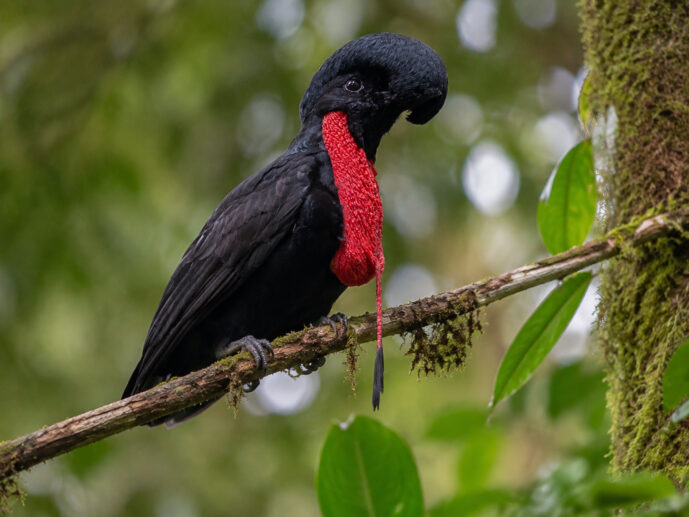
Most beautiful bird in Costa Rica N° 21 Bare-necked Umbrellabird
Most beautiful bird in Costa Rica N° 22 White-crested Coquette

Most beautiful bird in Costa Rica N° 23 Spectacled Owl
The Spectacled Owl (*Pulsatrix perspicillata*) is a striking nocturnal predator native to the dense rainforests of Central and South America, instantly recognizable by the "spectacles" of white feathers that frame its piercing yellow eyes. This large owl features a deep chocolate-brown head and back contrasted by a creamy-buff underbelly, creating a regal and imposing silhouette within the tropical canopy. While adults are masters of camouflage, their juveniles possess a unique and ghostly appearance, covered in fluffy white down with a startling black heart-shaped facial mask. Renowned for its deep, rhythmic hooting that sounds like a distant hammer striking a hollow log, the Spectacled Owl is a formidable hunter, capable of swooping down with silent precision to claim prey as large as opossums and small monkeys.

Most beautiful bird in Costa Rica N° 24 King Vulture
The King Vulture (*Sarcoramphus papa*) is a strikingly regal scavenger that stands out as one of the most colorful birds of prey in the tropical forests of Central and South America. While most vultures possess somber plumage, the King Vulture boasts a creamy white body contrasted by dark grey flight feathers and a thick, velvety neck ruff. Its most arresting feature is its featherless head and neck, which display a vivid kaleidoscope of orange, yellow, red, and purple skin, topped with a distinctive, fleshy orange caruncle above its powerful hooked beak. True to its name, this large raptor dominates the scavenging hierarchy; its superior size and immense beak strength allow it to tear through tough hides that smaller vultures cannot, granting it "royal" priority at every carcass it discovers.

Most beautiful bird in Costa Rica N° 25 Ferruginous Pygmy-Owl
Standing barely seven inches tall, the Ferruginous Pygmy-Owl (*Glaucidium brasilianum*) is a pint-sized powerhouse known for its bold personality and striking appearance. This sparrow-sized raptor features a round, tuftless head with piercing yellow eyes and prominent white "eyebrows" that give it a perpetually stern expression. While its plumage varies from a rich reddish-brown to a streaky gray, its most remarkable adaptation is a pair of black "false eyes" (ocelli) on the back of its neck, designed to deceive predators and pestering songbirds into thinking they are being watched from behind. Unlike many of its nocturnal relatives, this diurnal hunter is active during the day, frequently seen cocking its relatively long tail while perched in lowland thickets, where it fearlessly pursues prey often twice its own size.

Most beautiful bird in Costa Rica N° 26 Gartered Violaceous Trogon
The Gartered Trogon (*Trogon caligatus*) is a vibrant jewel of the Neotropical canopy, celebrated for its striking coloration and stoic presence. Males are particularly eye-catching, featuring a deep violet-blue head and breast that gives way to a brilliant yellow belly, all framed by a shimmering metallic green back and intricately barred black-and-white undertail feathers. Its most distinctive physical trait is the vivid yellow eye-ring, or "garter," which encircles its dark eyes and provides a sharp contrast to its dark face. Beyond its beauty, this species possesses a remarkable nesting strategy: it often excavates its home within active wasp or termite mounds, utilizing the stinging or biting insects as a built-in security system against predators. Whether sitting perfectly still on a shaded branch or performing acrobatic maneuvers to pluck fruit and insects, the Gartered Trogon remains one of the most charismatic and resourceful inhabitants of the tropical forest.

Most beautiful bird in Costa Rica N° 27 Barred Antshrike
The Barred Antshrike (*Thamnophilus doliatus*) is a striking Neotropical bird instantly recognizable by its bold, zebra-like plumage and expressive, erectile crest. This species exhibits dramatic sexual dimorphism: while the male is covered in high-contrast black and white horizontal bars, the female sports a warm, cinnamon-rufous coat with delicate black streaking on her head. A defining physical feature is its heavy, hooked bill—perfectly adapted for snatching insects and small vertebrates—complemented by piercing, pale-yellow eyes that give it a fierce expression. Renowned for its rhythmic, accelerating song that often echoes through forest edges and scrublands, the Barred Antshrike is as charismatic as it is visual, frequently puffing out its crown feathers to signal its presence or defend its territory.

Most beautiful bird in Costa Rica N° 28 Rufous-and-white Wren
The Rufous-and-white Wren (*Thryophilus rufalbus*) is a striking songbird of the Neotropics, easily recognized by its vibrant chestnut-red upperparts and contrasting, snowy-white underparts. Native to the dry forests and scrublands of Central and South America, this medium-sized wren features a bold white "eyebrow" stripe and intricate black-and-white barring on its wings and tail. While its plumage is visually sharp, its most enchanting feature is its liquid, flute-like song; these birds are masters of complex vocalizations, often engaging in sophisticated "antiphonal duetting" where mated pairs synchronize their melodies so perfectly they sound like a single individual. Secretive yet spirited, the Rufous-and-white Wren is a true gem of the forest undergrowth, combining architectural skill in building its flask-shaped nests with one of the most melodic and hauntingly beautiful voices in the avian world.

Most beautiful bird in Costa Rica N° 29 Scarlet Tanager
The Scarlet Tanager (*Piranga olivacea*) is a breathtaking songbird of the eastern North American forests, most famous for the male’s stunning breeding plumage of brilliant crimson offset by jet-black wings and a coal-black tail. Despite their fiery appearance, these birds are often elusive "forest ghosts," spending much of their time foraging high within the dense deciduous canopy for insects and fruit. A fascinating master of transformation, the male molts his red feathers for a cryptic olive-yellow coat in the winter, matching the year-round appearance of the female. Renowned for a unique, "burry" song that sounds like a robin with a sore throat, the Scarlet Tanager is also a remarkable long-distance traveler, migrating thousands of miles each year to spend the winter in the lush Amazon basin of South America.

Most beautiful bird in Costa Rica N° 30 Blue-necked Tanager
The Blue-necked Tanager (*Stilpnia cyanicollis*) is a small, spectacularly colored songbird native to the humid forests and woodland edges of South America. It is most renowned for its namesake feature: a brilliant, iridescent turquoise-blue head and neck that contrasts sharply against its velvety black underparts and back. Adding to its jewel-like appearance are its striking wings, which feature shimmering patches of golden-yellow or straw-colored feathers on the shoulders. These social birds are high-energy foragers, often seen flitting through the canopy in mixed-species flocks as they search for a diet of berries, seeds, and small insects. With its radiant plumage and high-pitched, metallic chirps, the Blue-necked Tanager serves as a vibrant and captivating gem of the tropical landscape.

Most beautiful bird in Costa Rica N° 31 Scarlet Macaw
The Scarlet Macaw (*Ara macao*) is a breathtaking neotropical parrot renowned for its vibrant explosion of color, featuring a brilliant red body accented by bold yellow wing coverts and deep blue flight feathers. Native to the humid rainforests of Central and South America, this large bird is easily identified by its long, pointed tail and powerful, hooked beak, which it uses with incredible dexterity to crack hard nuts and seeds. Beyond its striking appearance, the Scarlet Macaw is highly intelligent and social, often seen flying in pairs or small flocks while emitting raucous calls that echo through the canopy. Among its most fascinating traits are its zygodactyl feet—with two toes facing forward and two backward—which allow it to climb and manipulate food with the precision of a hand, and its habit of visiting riverbank clay licks to neutralize toxins in its diet, making it a true icon of tropical biodiversity.

Most beautiful bird in Costa Rica N° 32 White-eyed Parakeet
The White-eyed Parakeet (*Psittacara leucophthalmus*) is a vibrant and highly adaptable neotropical parrot native to the forests and urban landscapes of South America. Primarily cloaked in a lush emerald-green plumage, this medium-sized bird is most distinguished by the prominent patch of bare, creamy-white skin encircling its eyes, which provides a striking contrast to its dark irises and horn-colored beak. While it may appear uniform at rest, the parakeet reveals hidden splendor during flight, showcasing brilliant flashes of red and yellow feathers on its underwing coverts and the bend of the wing. Renowned for their intelligence, social nature, and impressive vocal mimicry, these resilient birds are often seen in boisterous flocks, making them one of the most charismatic and widespread members of the *Psittacara* genus.

Most beautiful bird in Costa Rica N° 33 Tody Motmot
The Tody Motmot (*Hylomanes momotula*) is a captivating avian gem, distinguished as the smallest member of the motmot family. Measuring only about 17 centimeters, this neotropical forest dweller sports a vibrant emerald-green body complemented by a rich cinnamon crown and a sharp black mask that streaks through its eyes. Unlike its larger relatives, the Tody Motmot is unique because it lacks the iconic racket-shaped tail feathers, possessing instead a short, square tail that contributes to its compact, tody-like silhouette. It is further identified by a subtle white stripe below its eye and a small tuft of black feathers centered on its chest. Known for its "sit-and-wait" hunting strategy, this elusive bird often remains perfectly still on low branches before darting out to snatch insects, making it a prized and charming sight within the dense undergrowth of Central and South America.

Most beautiful bird in Costa Rica N° 34 Spot-breasted Oriole
The Spot-breasted Oriole (*Icterus pectoralis*) is a vibrant and striking songbird primarily native to the Pacific slope of Central America, though it has famously established a naturalized population in the suburban gardens of southern Florida. Draped in a brilliant, fiery orange plumage that contrasts sharply with its jet-black wings, tail, and throat bib, this oriole is most distinguished by the unique cluster of black spots decorating the sides of its chest—a namesake feature that sets it apart from its relatives. Remarkably, unlike many other oriole species where females are often duller, both sexes of the Spot-breasted Oriole boast this same dazzling, high-contrast appearance. Beyond its tropical beauty, the bird is celebrated for its rich, flute-like whistles and its impressive ability to weave long, pendulous nests that sway from the tips of tree branches, making it both a visual and auditory treasure of the avian world.

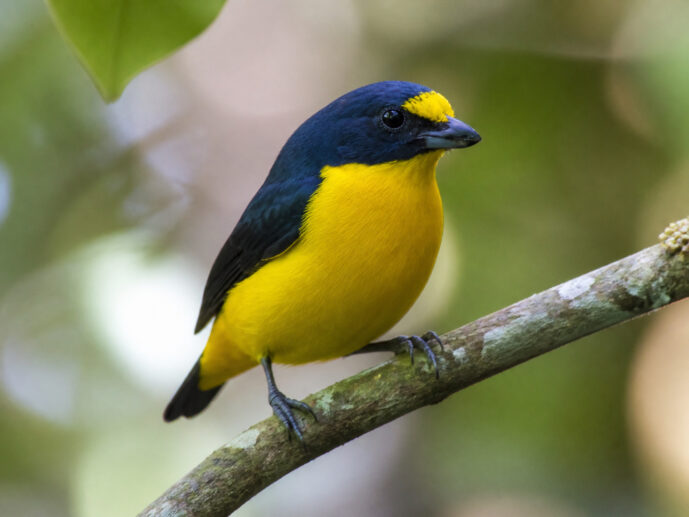
Most beautiful bird in Costa Rica N° 35 Yellow-throated Euphonia
Most beautiful bird in Costa Rica N° 36 White-throated Magpie-Jay

Most beautiful bird in Costa Rica N° 37 Elegant Euphonia

Most beautiful bird in Costa Rica N° 38 Slaty-tailed Trogon

Most beautiful bird in Costa Rica N° 39 White-winged Tanager

Most beautiful bird in Costa Rica N° 40 Indigo Bunting

Takeaways
- Split the trip by altitude band: build one base in the cloud forest and one in the lowland rainforest instead of commuting between them for single mornings.
- Anchor the route on quetzal and trogon mornings: reserve first light on a few days for cloud forest and let lowland and wetland species fill the rest.
- Keep one flexible day: when rain or mist closes a morning, that spare day is what protects the sessions the trip was built around.
Costa Rica earns the trip because one journey can cover several habitats: cloud forest for the Resplendent Quetzal and trogons, lowland rainforest for toucans, aracaris and manakins, and forest edge and clearings for hummingbirds and flycatchers. The decisions that matter come before booking: which altitude band gets your best mornings, whether Tortuguero or Corcovado earns its own block of days, and how much weather you are willing to work around.
If you would rather hand the logistics over, the Costa Rica Best Birding Hotspots Photography Tour: Carara to Sarapiqui follows a birding route from Carara to Sarapiqui and keeps photography at the centre of the day.
Questions fréquentes
Five standout birds to look for in Costa Rica include Resplendent Quetzal, Three-wattled Bellbird, Great Green Macaw, Snowcap and Bare-necked Umbrellabird. Cloud forest holds the quetzal and bellbird, while foothill and lowland forests offer the tiny Snowcap, the spectacular macaw and the elusive umbrellabird.
These are specialist targets rather than guaranteed sightings; the best choice depends on your route, season and the habitats you visit.
Pas nécessairement. Nous faisons généralement appel à des chauffeurs privés pour nos circuits, ce qui vous permet de profiter du trajet sans avoir à vous orienter sur des routes inconnues. Pour un trajet plus lent ou si vous tenez davantage à votre indépendance, nous pouvons plutôt vous proposer de louer un véhicule. Selon l’itinéraire, cette option peut aussi être plus économique. Nous discuterons des alternatives avec vous lors de la planification de votre itinéraire.
Le prix dépend de l'itinéraire, de la durée, de l'hébergement, du transport, des activités et du nombre de voyageurs. La proposition doit préciser ce qui est inclus et exclu.
Le climat du Costa Rica varie selon la région et l’altitude. La côte Pacifique connaît une saison sèche plus marquée, généralement de décembre à mars, tandis que les zones côtières des Caraïbes ont souvent des périodes relativement plus sèches en février–mars et en septembre–octobre. Il s’agit de tendances générales : vos centres d’intérêt, votre itinéraire et votre tolérance à la pluie comptent donc dans le choix des dates.
Cela dépend des régions que vous choisissez et de la fréquence à laquelle vous souhaitez changer d’hébergement. Nous pouvons vous aider à mettre en balance le nombre d’étapes et le temps disponible.
Keep exploring

Most beautiful National Parks in Costa Rica
Découvrez les paysages époustouflants du Costa Rica, d'Arenal à Corcovado, dans notre guide des parcs.

Most beautiful Beaches in Costa Rica
Découvrez les plus belles plages du Costa Rica pour une escapade inoubliable sous le soleil.
Costa Rica Birding & Photography Tour: Quetzal & Hummingbirds
A 13-day small-group birding and photography journey through Costa Rica's flagship habitats, from the quetzal country of the Talamanca Highlands to the cloud forests of Monteverde and the parrot-rich lowlands…

Costa Rica for photographers: A photography destination guide
Le Costa Rica est un paradis pour les photographes grâce à ses paysages à couper le souffle, à sa faune et à ses plages immaculées.

Best photography spots in Costa Rica

Reasons to visit Costa Rica
Explorez la biodiversité du Costa Rica, ses lieux d'aventure et son mode de vie pura vida !

Out of the Beaten Tracks places to visit in Costa Rica
Découvrez les joyaux cachés du Costa Rica, des plages isolées aux retraites luxuriantes de la forêt tropicale.

Best Hikes in Costa Rica
Explorez les meilleurs sentiers du Costa Rica, des panoramas d'Arenal à la faune du Corcovado.

Best Things to do in Costa Rica
Découvrez les meilleures activités du Costa Rica : des sources d'eau chaude d'Arenal aux forêts de nuages de Monteverde.
Costa Rica Photo Tour
Découvrez les paysages époustouflants et la faune vibrante lors de notre voyage photo au Costa Rica. Immortalisez des souvenirs inoubliables !
Costa Rica Best Birding Hotspots Photography Tour: Carara to Sarapiqui
Un circuit ornithologique de neuf jours au Costa Rica, au rythme tranquille, de la forêt sèche du Pacifique et de Carara aux hauts plateaux de Talamanca, aux contreforts des Caraïbes, à La Selva et à Cinchona.

Costa Rica Off the Beaten Track: Wildlife, Cloud Forest and Volcanoes
A 22-day cultural immersion and wildlife journey through Costa Rica, from Sarapiqui and Río Sarapiquí to Tortuguero, Boca Tapada, La Fortuna, Bijagua, Monteverde, Dominical and Manuel Antonio, with overnight bases…

Costa Rica Birding: Cloud Forest to Caribbean Lowlands
Des quetzals de la forêt de nuages aux toucans des basses terres caraïbes, un voyage à la découverte de la riche diversité ornithologique du Costa Rica.

Best Places to visit in Costa Rica
Explorez les hauts lieux du Costa Rica : Volcan Arenal, plages immaculées et forêts tropicales luxuriantes.

Costa Rica Ultimate Travel Guide
Guide ultime du Costa Rica : Forêts tropicales, plages et faune

Costa Rica Complete Birding Circuit: Carara, Osa & Savegre
Circuit ornithologique de 20 jours en petit groupe : forêts du Pacifique, péninsule d'Osa, Talamanca, forêt caribéenne, zones humides, Arenal, Monteverde.
Costa Rica Photography Birding Tour: Osa Peninsula & Savegre Valley
Un circuit ornithologique de 16 jours au Costa Rica, de la forêt sèche du Pacifique et de Carara en passant par la péninsule d'Osa, les hautes terres de Talamanca, les basses terres des Caraïbes, Arenal, Monteverde et La Ensenada.

Best time to visit Costa Rica
Découvrez la saison idéale pour la faune, les plages et les festivals au Costa Rica.

Vaccination & Health requirement to visit Costa Rica
Découvrez les dernières exigences du Costa Rica en matière de santé et de vaccins à l'entrée pour une visite sans tracas.

Budget to visit Costa Rica
Planifiez votre voyage au Costa Rica avec notre guide pour établir un budget pour le voyage, la nourriture et les activités.