Tangara à tête bleue
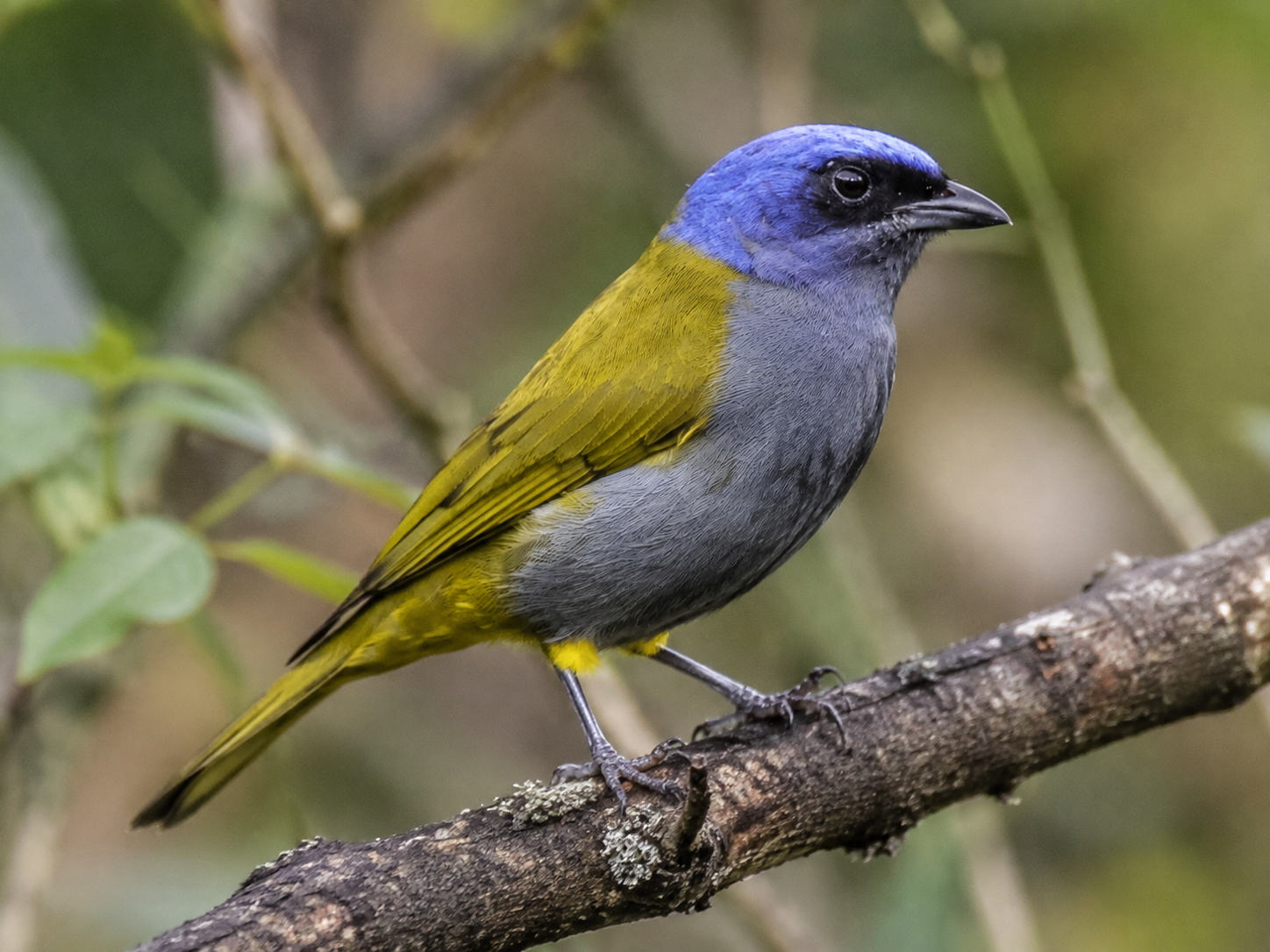
En bref
- Scientific Name: Sporathraupis cyanocephala
- Spanish Name: Tangara capiazul
- Famille : Thraupidae
- Known Nicknames: Blue-capped Mountain Tanager, Blue-necked Tanager
- Average Length: 15–17 cm / 5.9–6.7 in
- Average Weight: 28–40 g / 1.0–1.4 oz
- Envergure : N/A
- Key Feature: Bright blue cap and nape contrasting with olive-green body
- Primary Diet: Primarily Frugivore, also insectivorous
- Range: Andes of Venezuela, Colombia, Ecuador, Peru, and Bolivia
- Habitat: Montane cloud forest and humid highland forest edges
- Social Structure: Small flocks, often mixed-species foraging groups
- Nesting/Breeding: Cup-shaped nest in tree fork or shrub
- Statut de conservation : Préoccupation mineure (LC)
- Évolution démographique : Stable
The Blue-capped Tanager (*Sporathraupis cyanocephala*) is a dazzling resident of the Andean cloud forests, renowned for its striking, electric-blue crown that sharply contrasts with its velvety black face and throat. Its body is a softer, olive-green to yellowish tone, with pale blue shoulders and a whitish belly, creating a vivid mosaic of color. A special feature is its subtle iridescence; depending on the light, the blue cap can shimmer with a silvery or turquoise sheen. Highly social, it often travels in noisy, mixed-species flocks, gleaning fruit and insects from mossy branches, and its clear, whistled calls add a melodic layer to its misty montane habitat.
Faits amusants
Despite its name, the blue-capped tanager’s cap is not actually blue—it’s a vivid turquoise that can shift in intensity depending on the light. A quirky behavior is its habit of “anting,” where it deliberately rubs ants (or other small insects) onto its feathers, likely to use the formic acid as a natural insecticide and feather conditioner. This species also has a surprisingly complex social structure, often joining mixed-species foraging flocks and using specific, high-pitched contact calls to coordinate movements through the canopy.
Habitats et répartition
The Blue-capped Tanager is found in the Andes of South America, ranging from western Venezuela through Colombia, Ecuador, and Peru, with a disjunct population also occurring in northern Argentina. It inhabits humid montane forests, cloud forests, and forest edges, typically at elevations between 1,500 and 3,000 meters. Within these environments, it favors areas with dense mossy growth, epiphytes, and fruiting trees, often staying in the canopy or mid-story of mature forest and adjacent secondary growth.
Comportements & Reproduction
Blue-capped Tanagers are generally observed in small, loose flocks of up to a dozen individuals, often mixing with other tanager species while foraging. Their social structure is not rigidly hierarchical, but pairs appear to form stable monogamous bonds during the breeding season. Mating begins with mutual preening and the male performing a short, vertical display flight while singing, after which the female solicits copulation by quivering her wings. Nest construction is solely the female’s task: she builds a cup-shaped nest from moss, rootlets, and spider webs, typically placed in a tree fork or bromeliad 2–6 meters above ground. Clutch size is usually two pale blue eggs with brown speckles, and the female alone incubates them for about 14 days. The male assists by bringing food to the incubating female and later helps feed the nestlings, which fledge after roughly 15–18 days. A unique reproductive strategy is the frequent reuse of the same nest site across successive years, with the female often reinforcing the old structure rather than building anew, which conserves energy. Post-fledging, juveniles remain with the parents for several weeks, learning foraging techniques before dispersing.
Alimentation
The Blue-capped Tanager is primarily frugivorous, with a diet consisting mainly of small fruits and berries, particularly favoring mistletoe fruits, which it actively seeks out in the canopy and edges of montane forests. It supplements this fruit-heavy diet with a variety of insects and spiders, often gleaning them from foliage or catching them in short, agile flights. An interesting dietary fact is that this tanager will occasionally visit banana feeders at lodges and reserves, showing a preference for soft, ripe fruit over harder offerings. Additionally, its strong reliance on mistletoe berries makes it a key seed disperser for these parasitic plants, playing a crucial role in the forest’s ecological dynamics.
Couleurs
The Blue-capped Tanager has a vibrant blue crown and nape, contrasting with a black mask around the eyes and a bright yellow-green body. Its wings and tail are dark blue-black with turquoise edging, while the throat and breast are a paler yellow. It lacks camouflage adaptations, instead relying on conspicuous coloration for social signaling in its Andean cloud forest habitat.
