<trp-post-container data-trp-post-id='360676'>White-faced Whistling-Duck
Dendrocygna viduata
Open Bird Bucket List ↗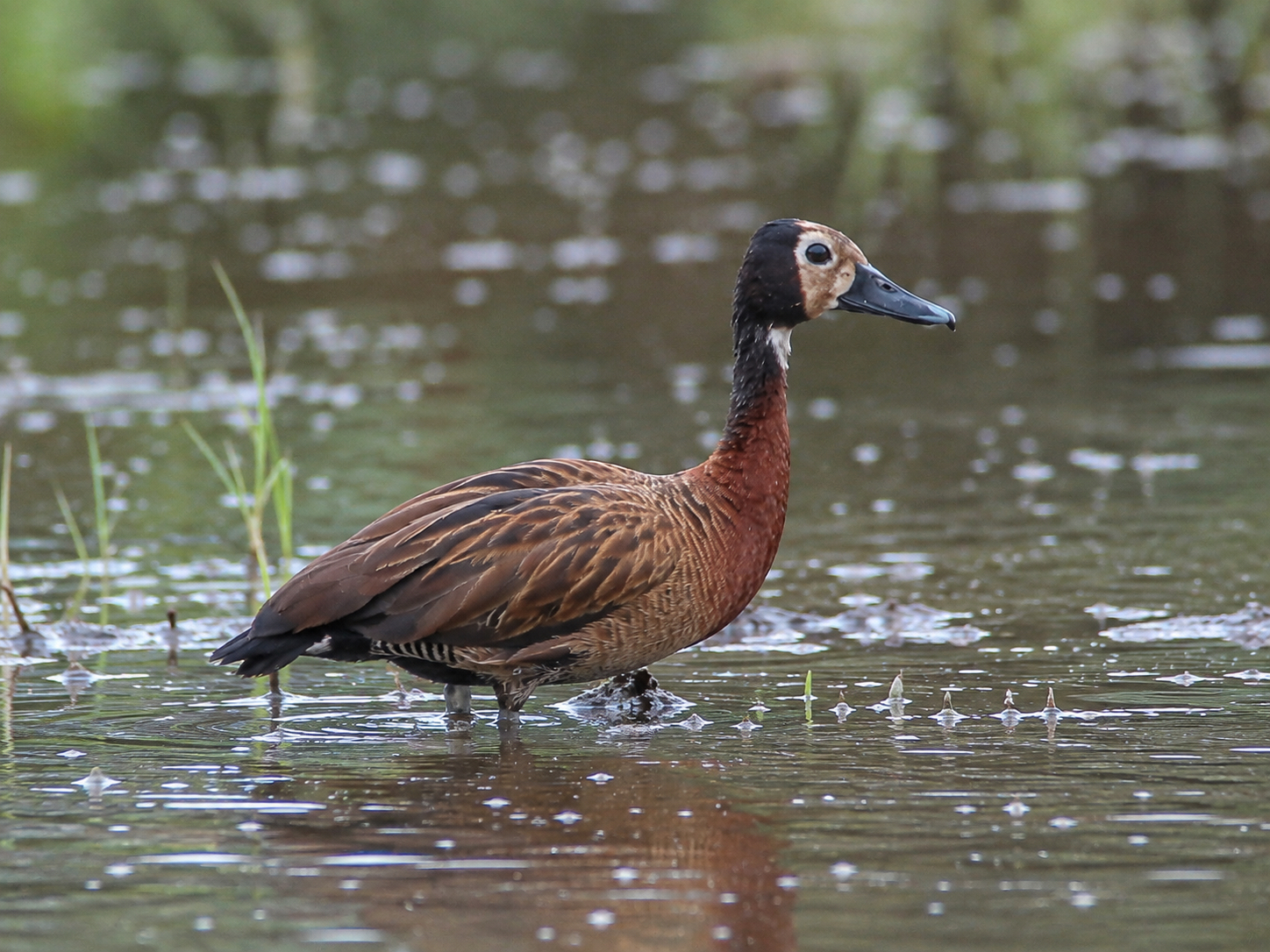
En bref
- Scientific Name: Dendrocygna viduata
- Spanish Name: Pato silbón cariblanco
- Famille : Anatidae
- Known Nicknames: White-faced Tree Duck, White-faced Whistling Duck, Whistling Teal
- Average Length: 43–48 cm / 17–19 in
- Average Weight: 550–820 g / 19–29 oz
- Wingspan: 75–90 cm / 30–35 in
- Key Feature: Striking white face and forecrown contrasting with black nape and neck
- Primary Diet: Omnivore (seeds, aquatic plants, insects, small invertebrates)
- Range: Sub-Saharan Africa, Madagascar, and South America (Colombia to Argentina)
- Habitat: Shallow freshwater wetlands, lakes, marshes, and rice paddies
- Social Structure: Highly Social (forms large flocks, often mixed with other whistling-ducks)
- Nesting/Breeding: Tree cavities, hollow logs, or dense vegetation near water
- Statut de conservation : Préoccupation mineure (LC)
- Évolution démographique : Stable
The White-faced Whistling-Duck (*Dendrocygna viduata*) is a striking and gregarious waterfowl, instantly recognizable by its bold, stark-white face and crown that contrast sharply with its black nape and neck. Its body is a rich tapestry of chestnut, buff, and black, with long, elegant legs and a distinctive, upright posture that sets it apart from typical ducks. As its name suggests, this species is famous for its high-pitched, three-note whistling call, a sound that carries across its wetland habitats in sub-Saharan Africa and South America. A unique feature is its strong, nocturnal feeding habits—often foraging in flocks at night for seeds and aquatic plants—while its long legs and slightly webbed feet make it equally adept at perching in trees as swimming, a rare combination among ducks.
Faits amusants
Despite their elegant appearance, these ducks have a bizarre, almost alien-like social habit: they frequently engage in "allopreening" where they nibble each other’s heads and necks, but they also perform a synchronized, high-speed head-bobbing display that looks like a frantic nod of agreement. They are also remarkably vocal, producing a distinctive, clear, three-note whistle that sounds like a human wolf-whistle, which they use to coordinate in dense flocks. An unusual adaptation is their ability to perch on branches and even telephone wires, thanks to strong, sharp claws, a trait rare among ducks. Furthermore, they are known to feed nocturnally, using their long legs to wade in shallow water while their heads are submerged, a behavior that minimizes competition with daytime-feeding waterfowl.
Habitats et répartition
The White-faced Whistling-Duck is widely distributed across sub-Saharan Africa, Madagascar, and the Comoros Islands, with a separate population in southern and eastern South America, including parts of Colombia, Venezuela, Brazil, Uruguay, and northern Argentina. Its preferred habitats are shallow freshwater wetlands such as marshes, flooded grasslands, lagoons, and the margins of lakes and rivers, where it can feed on aquatic plants, seeds, and small invertebrates. It also readily occupies man-made environments like rice paddies, sewage ponds, and reservoirs, often gathering in large flocks during the non-breeding season.
Comportements & Reproduction
Highly social and gregarious, they form large flocks outside the breeding season, often mixing with other whistling-duck species. Their pair bonds are thought to be long-term, possibly lifelong, and courtship involves mutual head-pumping and synchronized preening. Nesting typically occurs in tree cavities, dense vegetation, or occasionally on the ground near water, with both parents sharing incubation duties for about 28-30 days. A unique reproductive strategy is the frequent occurrence of "dump nesting," where multiple females lay eggs in a single nest, resulting in large clutches of up to 20 or more eggs. Both parents actively defend the nest and brood, and the precocial ducklings leave the nest shortly after hatching, led by both adults to feeding areas.
Alimentation
The White-faced Whistling-Duck is primarily a nocturnal herbivore, foraging at night in shallow wetlands, flooded grasslands, and rice paddies. Its diet consists mainly of seeds from grasses and aquatic plants, particularly wild rice and sedges, which it sifts from mud and water using its specialized bill. It also consumes small quantities of aquatic invertebrates, such as insects, mollusks, and crustaceans, especially during the breeding season to obtain extra protein. An interesting fact is that this duck often feeds in large, noisy flocks, and its diet can shift seasonally, relying heavily on agricultural crops like fallen rice grains, which sometimes brings it into conflict with farmers. Additionally, it has a unique adaptation: its gizzard is highly muscular, allowing it to grind tough seeds that other waterfowl cannot process.
Couleurs
The White-faced Whistling-Duck has a striking white face and forecrown contrasted by a black nape and hindneck. Its body is a warm chestnut-brown on the breast and flanks, with bold black-and-white barring on the sides and a black tail. The wings are dark brown with a distinctive chestnut patch, and the long legs and bill are slate-gray. This high-contrast facial pattern serves as species recognition, not camouflage, while the barred flanks provide disruptive coloration against dappled water and reeds.
Distribution Map
Places linked to this species. A sighting is never guaranteed.
Use the map filter to show only featured places.
Featured places
Tours where this species is featured

