<trp-post-container data-trp-post-id='360384'>Magpie Tanager
Open Bird Bucket List ↗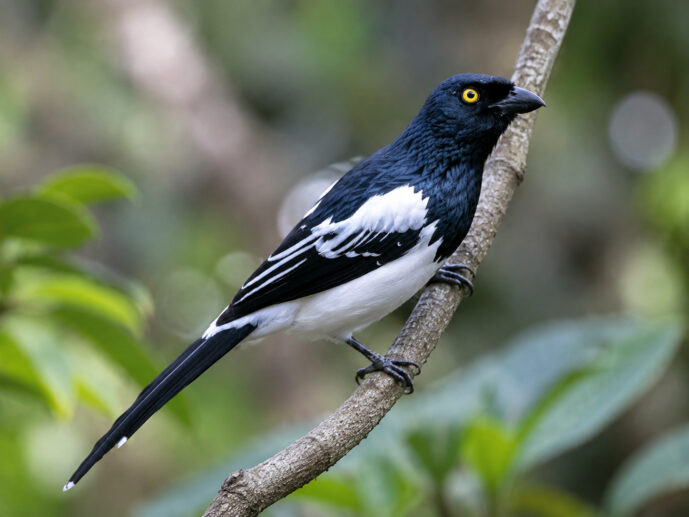
En bref
- Scientific Name: Cissopis leverianus
- Spanish Name: Tangara urraca
- Famille : Thraupidae
- Known Nicknames: Pica-pica, Black-and-white Tanager
- Average Length: 25–30 cm / 10–12 in
- Average Weight: 69–90 g / 2.4–3.2 oz
- Wingspan: 30–35 cm / 12–14 in
- Key Feature: Long, graduated black-and-white tail with white outer rectrices
- Primary Diet: Primarily Frugivore and Insectivore
- Range: Amazon and Orinoco basins, from Colombia and Venezuela to Bolivia and Brazil
- Habitat: Forest edges, riverine forests, and secondary growth
- Social Structure: Small flocks or pairs
- Nidification/Reproduction : Nid en forme de coupe ouverte dans la fourche d'un arbre
- Statut de conservation : Préoccupation mineure (LC)
- Évolution démographique : Stable
The Magpie Tanager (*Cissopis leverianus*) is a strikingly bold and unmistakable songbird of South American lowland forests, renowned for its dramatic black-and-white plumage that mimics a magpie’s color scheme but with a unique tropical twist. This large tanager, reaching about 25–27 cm (10–10.6 inches) in length, boasts a glossy black head, back, wings, and long, graduated tail, contrasted starkly by pure white underparts and a white patch on the wing. Its most special feature is the vivid, bare yellow-orange skin around the eye and on the base of the lower mandible, giving it a perpetually alert, almost clown-like expression. Additionally, it possesses a thick, silver-blue bill and a distinctive, rattling call often heard as it noisily forages in small flocks through the canopy, snatching fruit and insects with agile, acrobatic hops.
Faits amusants
Despite its flashy black-and-white magpie-like plumage, the magpie tanager has a peculiar habit of sunbathing with its wings spread wide on forest paths, a behavior thought to help rid its feathers of parasites. It is one of the largest tanagers, reaching up to 10 inches (25 cm), and uses its long tail for sharp, acrobatic turns while chasing insects in mid-air. A quirky twist: when alarmed, the entire flock may freeze in place, tilting their heads upward in a synchronized “sky-pointing” pose that makes them look like tiny, feathered statues.
Habitats et répartition
The Magpie Tanager inhabits lowland and foothill forests, primarily within the Amazon Basin. It is found in humid tropical rainforests, often along forest edges, near rivers, and in clearings with scattered trees, as well as in secondary growth and occasionally in plantations. Its geographical range extends across northern and central South America, including southern Venezuela, Colombia, Ecuador, Peru, northern Bolivia, and the Amazonian regions of Brazil, as well as the Guianas and Trinidad and Tobago.
Comportements & Reproduction
The Magpie Tanager is highly social, typically found in small, noisy flocks of 4 to 12 individuals that maintain cohesive group dynamics while foraging in the canopy. Their mating habits involve strong pair bonds within these flocks, with both parents cooperating in nest construction, incubation, and feeding of young. They build a deep, cup-shaped nest from plant fibers and spiderwebs, often placed in dense foliage to reduce predation. A unique reproductive strategy is their use of cooperative breeding; non-breeding flock members, often offspring from previous broods, assist in defending the nest and provisioning chicks, increasing fledgling survival rates. Clutches are small, usually two to three eggs, with a relatively short incubation period of around 13–14 days, allowing for multiple broods per season in favorable conditions.
Alimentation
The Magpie Tanager is primarily frugivorous, with fruit constituting the bulk of its diet, particularly favoring berries and small soft fruits from trees and shrubs like those in the *Melastomataceae* family. However, it is an opportunistic omnivore, regularly supplementing its fruit intake with a variety of arthropods, including beetles, caterpillars, and spiders, which it actively forages for by gleaning leaves and branches in the mid to upper canopy. An interesting dietary habit is its frequent participation in mixed-species foraging flocks, where it follows groups of other birds like antbirds or tanagers to snatch insects flushed out by their movements. Additionally, it has been observed occasionally consuming flower nectar and small seeds, showcasing a flexible feeding strategy that adapts to seasonal resource availability in its South American rainforest habitat.
Couleurs
The Magpie Tanager is predominantly black and white, with a long, graduated black tail edged in white and a white belly contrasting with a black hood, back, and wings. Its most unique feature is a bright yellow iris, which stands out against the dark head. It has no specific camouflage adaptations, as its bold, contrasting plumage is conspicuous in its forest-edge and open-canopy habitats.
Distribution Map
Places linked to this species. A sighting is never guaranteed.
Use the map filter to show only featured places.
Featured places
- Reserva Ecológica de Guapiaçu (REGUA)
- Trilha Dos Tucanos Day 2 AM
- White-masked Antbird Forest (San Lorenzo, Marañón)
- Wild Sumaco Birding Road
Tours where this species is featured


