Petit Chevalier
En bref
- Scientific Name: Tringa flavipes
- Spanish Name: Archibebe Patiamarillo Menor
- Family: Scolopacidae
- Known Nicknames: Lesser Yellow-legs, Yellowlegs, Yellow-legged Plover
- Average Length: 23–25 cm / 9–10 in
- Average Weight: 48–114 g / 1.7–4.0 oz
- Wingspan: 59–64 cm / 23–25 in
- Key Feature: Long, bright yellow legs and a slender, straight bill
- Primary Diet: Primarily Carnivore (insects, crustaceans, small fish, and amphibians)
- Range: Breeds in boreal North America (Alaska to Newfoundland); winters from the southern United States through Central and South America to Tierra del Fuego
- Habitat: Freshwater wetlands, marshes, mudflats, flooded fields, and shorelines
- Social Structure: Social (migrates and forages in loose flocks; solitary or territorial during breeding)
- Nesting/Breeding: Ground nest in a shallow depression near water, often concealed in grass or moss
- Statut de conservation : Préoccupation mineure (LC)
- Évolution démographique : En baisse
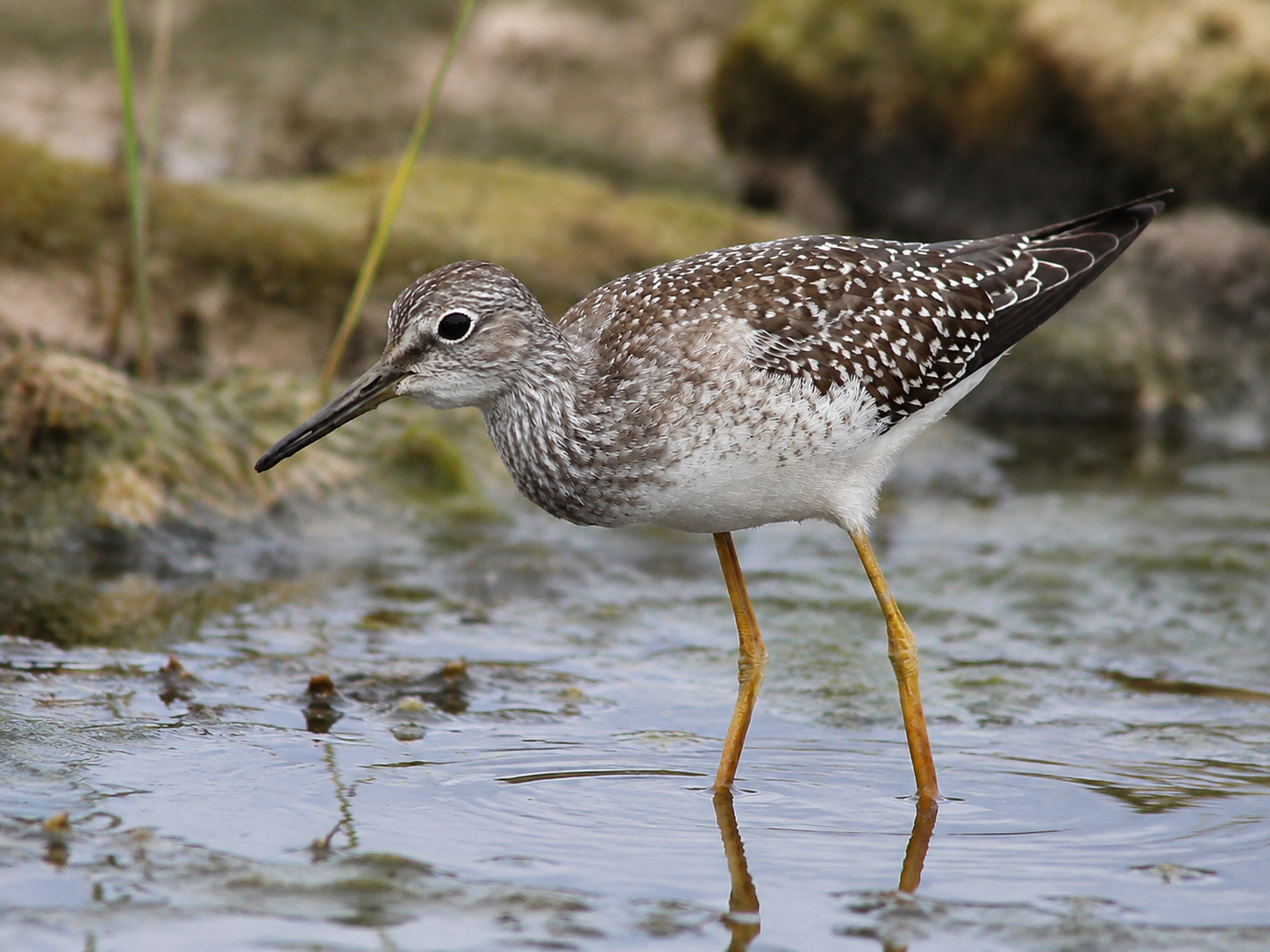
The Lesser Yellowlegs (*Tringa flavipes*) is a sleek, elegant shorebird renowned for its strikingly long, bright yellow legs, which give it a distinctive, almost stilt-like appearance as it forages in shallow wetlands across North America. Smaller and more delicate than its larger cousin, the Greater Yellowlegs, this bird boasts a slender, straight black bill and a crisp, finely streaked gray-brown back and breast that transitions to a clean white belly. A special feature is its graceful, often nervous behavior—constantly bobbing its head and tail while picking through mudflats for insects, small fish, and crustaceans. During migration, its clear, three-note whistle—*tu-tu-tu*—echoes across marshes, making it one of the most recognizable voices of North American wetlands.
Faits amusants
One of the most quirky behaviors of the Lesser Yellowlegs is its "foot-trembling" feeding technique, where it rapidly vibrates one foot in shallow water to startle hidden prey like small fish and insect larvae into movement. Despite its delicate appearance, this bird is a long-distance migration champion, flying non-stop over the Atlantic Ocean from New England to South America—a journey of up to 3,000 miles without rest. It also has a peculiar alarm call that sounds like a sharp, whistled "tu-tu," often repeated in a panicked series that can be confused with the similar Greater Yellowlegs, but is distinctly higher-pitched and more rapid.
Habitats et répartition
The Lesser Yellowlegs breeds in the boreal forests and open taiga of Alaska and northern Canada, favoring wet meadows, bogs, and muskegs near shallow ponds and lakes. During migration and winter, it shifts to a wide variety of freshwater and brackish wetlands, including coastal mudflats, flooded fields, salt marshes, and the edges of lakes and rivers. Its winter range extends from the southern United States through Central America and the Caribbean, reaching as far south as southern South America, including Argentina and Chile.
Comportements & Reproduction
During the breeding season, Lesser Yellowlegs are generally solitary or found in loose, scattered pairs, defending nesting territories in northern boreal wetlands. Mating involves aerial displays where the male flies in wide circles, singing a sharp, whistled song, before descending to the ground to court the female with postures and wing-lifts. The nest is a simple scrape on dry ground, often near water or under low shrubs, lined with grass and leaves. Both parents share incubation duties for about 22–23 days, but a unique reproductive strategy is that the female often departs shortly after the eggs hatch, leaving the male to care for the precocial chicks alone until they fledge at around 18–20 days. This uniparental male care is relatively common among sandpipers and allows the female to potentially initiate a second brood with a different male in the same season, though this is less frequent in this species.
Alimentation
The Lesser Yellowlegs is an opportunistic carnivore, primarily feeding on a diverse array of small aquatic and terrestrial invertebrates. Its diet consists mainly of insects such as beetles, flies, dragonfly larvae, and grasshoppers, along with spiders, snails, small crustaceans like amphipods and fairy shrimp, and occasionally small fish or tadpoles. An interesting fact about its feeding behavior is that it often hunts by sight, actively running through shallow water with its head down, pecking at prey on the surface or just below, and it will also use a "foot-trembling" technique where it vibrates one foot in the mud to disturb hidden invertebrates, making them easier to catch. Unlike some shorebirds, it rarely probes deeply into mud, preferring to snatch prey from the water column or sediment surface.
Couleurs
The Lesser Yellowlegs has a mottled brownish-gray back and wings with fine white speckling, a white belly and undertail, and a streaked white head and neck. Its most distinctive feature is its bright yellow legs, which contrast sharply with its dark, straight, slender bill. In breeding plumage, the upperparts become darker with more distinct blackish barring and spots, while in winter the plumage is paler and more uniform, providing camouflage against mudflats and marshes.
