<trp-post-container data-trp-post-id='360533'>Hooded Tanager
Open Bird Bucket List ↗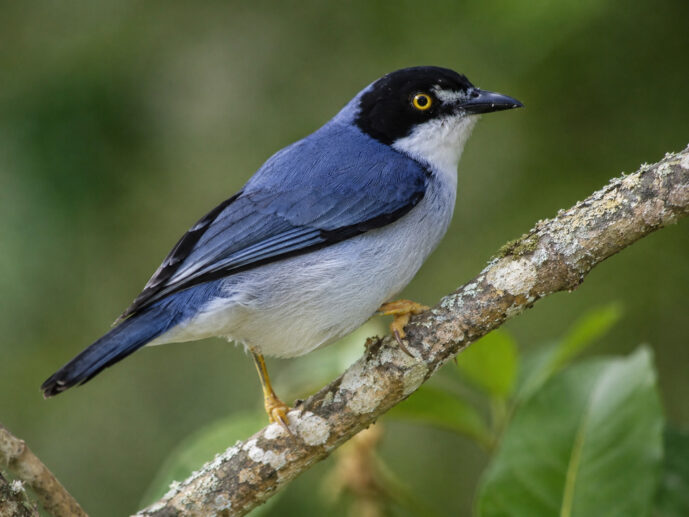
En bref
- Scientific Name: Nemosia pileata
- Spanish Name: Tangara capirotada
- Famille : Thraupidae
- Known Nicknames: Hooded Tanager, Red-collared Tanager (obsolete)
- Longueur moyenne : 13–14 cm / 5,1–5,5 pouces
- Average Weight: 16–22 g / 0.56–0.78 oz
- Envergure : N/A
- Key Feature: Black hood and bright white throat contrasting with a yellow or orange breast
- Primary Diet: Primarily Frugivore, also insectivore
- Range: Northern and central South America (Colombia, Venezuela, the Guianas, Brazil, Bolivia, Paraguay, and northern Argentina)
- Habitat: Tropical lowland forests, forest edges, and secondary growth
- Social Structure: Often in small flocks or mixed-species foraging parties
- Nesting/Breeding: Open-cup nest in a tree fork
- Statut de conservation : Préoccupation mineure (LC)
- Évolution démographique : Stable
The Hooded Tanager (*Nemosia pileata*) is a striking small songbird of South America, renowned for its bold, minimalist plumage and unique foraging behavior. The male is particularly eye-catching with a jet-black hood that sharply contrasts with a pure white throat, underparts, and wing patches, set against a pale blue-grey back and wings. Females are more subdued, lacking the black hood and instead showing a soft grey head with a white eyering. A special feature of this species is its acrobatic feeding style: it often hangs upside-down like a titmouse to glean insects and berries from foliage, a trait uncommon among tanagers. Its bright, clear “tsee-tsee-tsee” call and preference for the canopy of humid forests, gallery woodlands, and savanna edges make it a lively, if sometimes elusive, presence for birdwatchers.
Faits amusants
The Hooded Tanager has a bizarre courtship ritual where the male performs a "moth flight," fluttering his wings so rapidly they become a blur while emitting a high-pitched, insect-like buzz, a behavior unique among tanagers. It also possesses a peculiar adaptation: its tongue is tipped with a brush-like structure of bristles, which it uses to swipe up sticky fruit pulp and nectar more efficiently than its relatives. Oddly, this species is known to occasionally "ant," a behavior where it picks up ants and rubs them through its feathers, likely to use the formic acid as a natural insecticide against parasites.
Habitats et répartition
The Hooded Tanager primarily inhabits tropical and subtropical lowland forests, favoring humid environments such as terra firme forests, gallery forests, and forest edges. It is also commonly found in second-growth woodlands, clearings with scattered trees, and occasionally in plantations and gardens, typically staying in the canopy or mid-story. Its geographical range spans a large portion of northern and central South America, occurring in the Amazon Basin across Brazil, Colombia, Venezuela, Ecuador, Peru, Bolivia, and the Guianas, as well as in the Pantanal and parts of the Cerrado. It is generally resident throughout this range, though local movements may occur in response to seasonal flooding.
Comportements & Reproduction
The Hooded Tanager is typically observed in small, loose flocks of up to a dozen individuals, often joining mixed-species foraging groups. Their social structure appears fluid outside of the breeding season, with pairs forming only during the reproductive period. Mating is monogamous for the season, and courtship involves the male performing a simple display of fluffed plumage and short, rapid flights near the female while singing a high-pitched, thin song. The female builds a small, cup-shaped nest from rootlets and spiderwebs, usually placed in a fork of a tree or shrub. She lays a clutch of two to three pale eggs with dark speckles, and incubation is performed solely by the female, lasting about 13 to 14 days. Both parents feed the chicks, which fledge after roughly two weeks. A notable reproductive strategy is the species' frequent use of abandoned nests of other birds, such as flycatchers or oropendolas, which may reduce predation risk and energy expenditure on nest construction.
Alimentation
The Hooded Tanager (Nemosia pileata) is primarily a frugivore, with its diet heavily centered on a variety of small, soft fruits and berries, which it plucks directly from trees and shrubs in the canopy and understory. It supplements this fruit-heavy base with a significant portion of arthropods, actively gleaning insects, spiders, and their larvae from leaves, bark, and branches, often while foraging in mixed-species flocks. An interesting aspect of its feeding behavior is its versatility; it will occasionally visit flowering trees to consume nectar, and it has been observed catching small prey in short, agile sallies into the air, a technique more common in flycatchers. This dietary flexibility allows it to exploit seasonal changes in food availability, shifting from a fruit-dominated diet in wet seasons to a more insectivorous one when fruits are scarce.
Couleurs
The Hooded Tanager has a striking black hood covering the head, throat, and upper chest, contrasting sharply with a pure white belly and underparts. The upperparts are a soft bluish-gray, while the wings and tail are darker with subtle blue edges. Females lack the black hood, showing a gray head and paler underparts. No specific camouflage adaptations are noted; its bold coloration serves more for social signaling.
Distribution Map
Places linked to this species. A sighting is never guaranteed.
Use the map filter to show only featured places.
Featured places
Tours where this species is featured


