<trp-post-container data-trp-post-id='359663'>Crested Caracara
Open Bird Bucket List ↗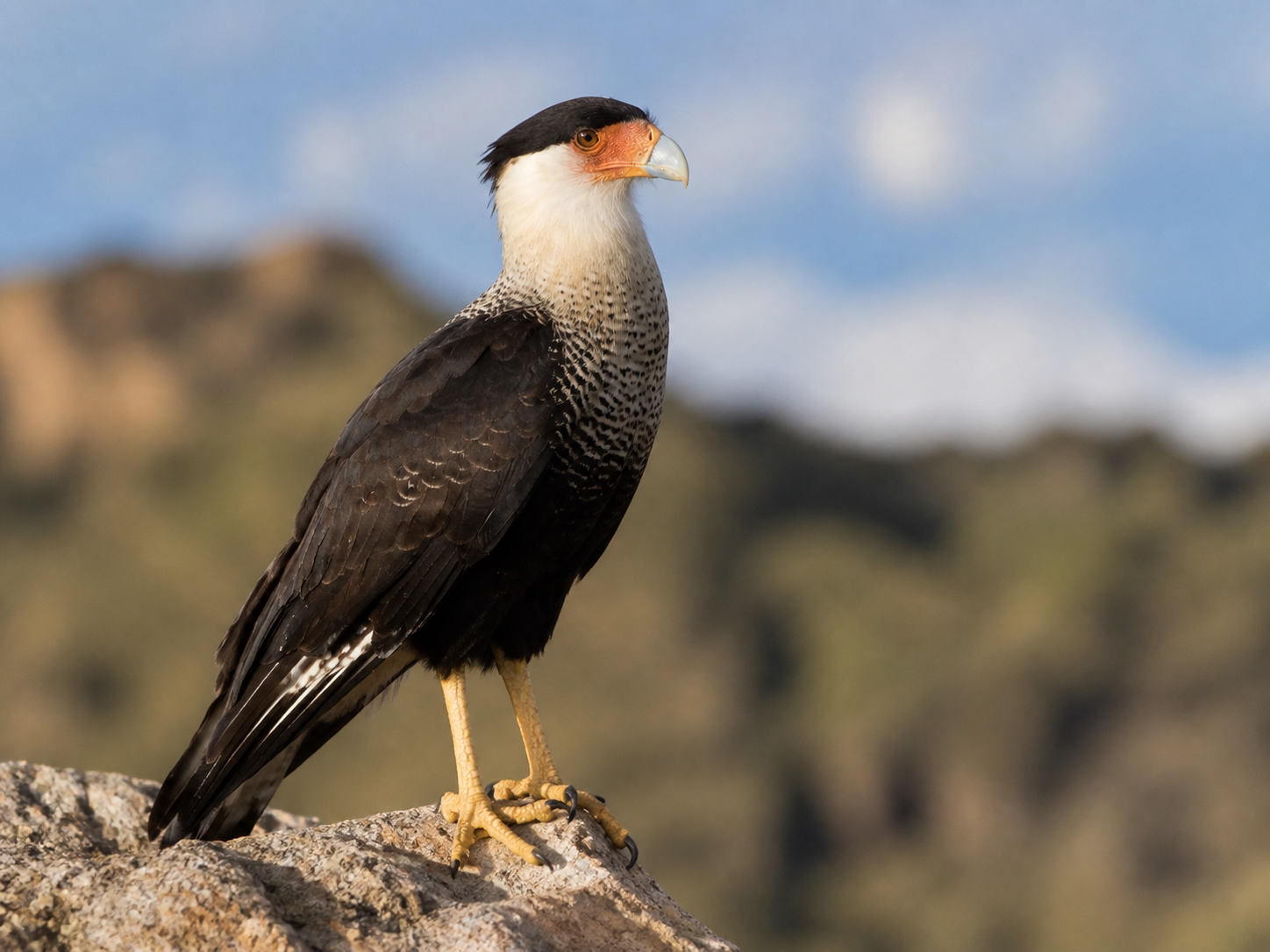
En bref
- Scientific Name: Caracara plancus
- Spanish Name: Caracara crestado
- Family: Falconidae
- Known Nicknames: Mexican Eagle, Northern Caracara, Audubon's Caracara
- Average Length: 49–58 cm / 19–23 in
- Average Weight: 800–1,400 g / 1.8–3.1 lb
- Wingspan: 120–132 cm / 47–52 in
- Key Feature: Bare orange-red facial skin and thick, hooked grey bill
- Primary Diet: Omnivore (scavenger and active predator)
- Range: Southern United States (Texas, Arizona, Florida) through Central America to Tierra del Fuego
- Habitat: Open grasslands, savannas, ranchlands, and coastal scrub
- Social Structure: Solitary or in pairs; sometimes in small family groups
- Nesting/Breeding: Bulky stick nest in cacti, palm trees, or on man-made structures
- Statut de conservation : Préoccupation mineure (LC)
- Évolution démographique : Stable
The Crested Caracara (*Caracara plancus*) is a strikingly unique raptor of the Americas, often described as a "falcon that acts like a vulture" due to its omnivorous, ground-foraging habits. Standing about 20–25 inches tall with a wingspan of up to 4 feet, it sports a bold, unmistakable appearance: a flat, black cap contrasts sharply with a bare, orange-red face and a heavy, hooked gray beak. Its long legs and broad wings are set off by a white neck and chest, while the body is dark brown with a distinctive white-barred tail and white patches near the wingtips. A special feature is its crest—a shaggy, upright tuft of feathers on the crown that it raises when excited or threatened. Unlike most falcons, this caracara is a bold scavenger and opportunistic hunter, often seen striding across open fields or perched on fence posts, using its strong feet to flip over cow patties in search of insects.
Faits amusants
The Crested Caracara is a falcon that acts like a vulture, often stealing food from other birds or scavenging roadkill, but it’s also an accomplished hunter that will flip cow patties with its beak to grab dung beetles underneath. It has a bizarre, almost comical habit of walking on the ground for long distances instead of flying, striding along with a stiff, bobbing gait that makes it look like a tiny, feathered dinosaur. Unlike most raptors, it builds its own messy stick nest in cacti or palm trees rather than taking over another bird’s abandoned home, and it’s known to store leftovers by impaling them on thorns or wedging them into crevices for later. Its bare, red-orange face skin changes color with mood or excitement, and it can mimic the calls of other birds, including hawks and crows.
Habitats et répartition
The Crested Caracara occupies open and semi-open landscapes across a broad geographical range that extends from the southern United States through Mexico and Central America, and across much of South America down to Tierra del Fuego. It is notably absent from dense, humid rainforests like the Amazon basin. Typical habitats include grasslands, savannas, ranchlands, agricultural fields, arid scrublands, and coastal lowlands, where it often perches conspicuously on fence posts, utility poles, or low trees. It thrives in environments with a mix of open ground for foraging and scattered elevated perches for hunting and roosting, frequently associating with cattle pastures and areas where carrion is abundant.
Comportements & Reproduction
The Crested Caracara exhibits a complex social structure, often found in pairs or small family groups, though they may congregate in larger numbers at abundant food sources like carcasses. Mating is monogamous, with pairs forming strong, long-term bonds that persist year-round, reinforced by mutual preening and aerial displays. Breeding season varies by region, typically occurring from late winter to early spring. They build a bulky, untidy nest of sticks and debris in a tree, cactus, or even on the ground, frequently reusing and enlarging the same nest annually. The female lays 2 to 3 eggs, which both parents incubate for about 30 days. A unique reproductive strategy is their cooperative breeding system, where offspring from previous broods often remain with the parents to help defend the territory and feed the new chicks, increasing fledgling survival rates. The young fledge at around 7 to 8 weeks but may stay dependent on the family group for several more months.
Alimentation
The Crested Caracara is an opportunistic omnivore with a remarkably varied diet that heavily relies on carrion, often scavenging along roadsides or following vultures to fresh kills of mammals, birds, and reptiles. Unlike many raptors, it actively forages on foot, flipping over cow dung, rocks, and debris to catch insects, worms, and small vertebrates like frogs or lizards. It is also a known kleptoparasite, stealing food from other birds, and will occasionally prey on weak or newborn livestock such as lambs and calves. A particularly interesting fact is its fondness for palm fruits and other berries, making it one of the few falconids that regularly incorporates plant matter into its meals, especially during seasons when animal prey is scarce.
Couleurs
The Crested Caracara has a blackish-brown body and wings contrasting with a white neck, chest, and tail base tipped in black. Its bare face skin is orange to red, with a dark cap and crest. The legs are yellow. This bold pattern lacks camouflage, instead serving as conspicuous identification in open habitats.
Distribution Map
Places linked to this species. A sighting is never guaranteed.
Use the map filter to show only featured places.
Featured places
Tours where this species is featured

