<trp-post-container data-trp-post-id='361062'>Black-billed Mountain-Toucan
Open Bird Bucket List ↗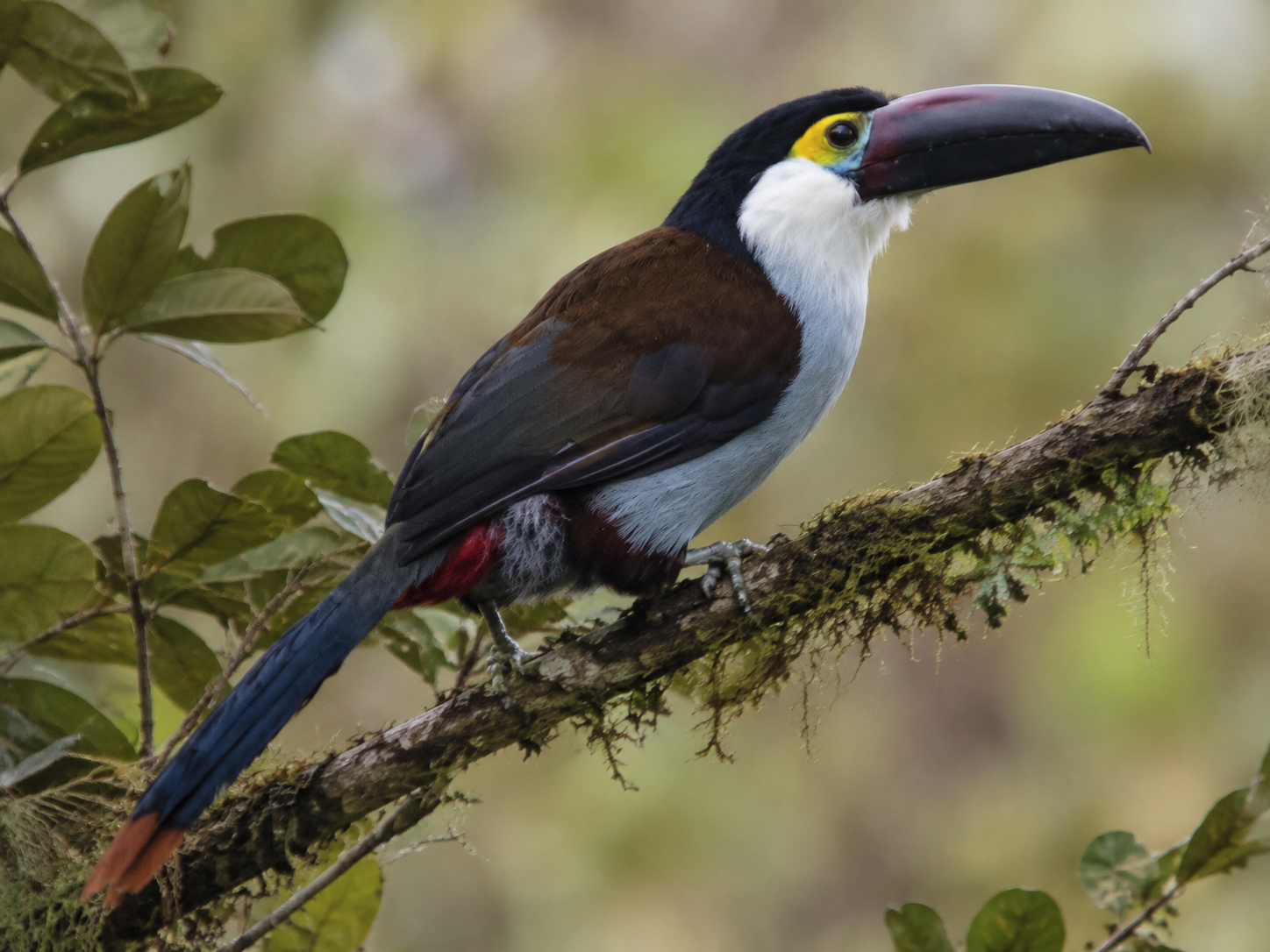
En bref
- Scientific Name: Andigena nigrirostris
- Spanish Name: Tucán montañés piquinegro
- Family: Ramphastidae
- Known Nicknames: Black-billed Mountain Toucan, Plate-billed Mountain-Toucan
- Longueur moyenne : 46–51 cm / 18–20 pouces
- Average Weight: 300–400 g / 10.6–14.1 oz
- Envergure : N/A
- Key Feature: Black bill with a yellow-orange stripe at the base and a blue-gray throat
- Régime alimentaire principal : Principalement frugivore
- Aire de répartition : Andes de Colombie, d'Équateur et du nord du Pérou
- Habitat: Montane cloud forests and humid highland forests
- Social Structure: Small flocks or pairs
- Nesting/Breeding: Tree cavities
- Statut de conservation : Préoccupation mineure (LC)
- Évolution démographique : Stable
The Black-billed Mountain-Toucan (*Andigena nigrirostris*) is a striking high-altitude specialist found in the cloud forests of the Andes, from Colombia to Peru. Unlike its lowland cousins, this toucan boasts a unique, mostly black bill with a vivid yellow base and a subtle blue-grey wash, perfectly complementing its slate-grey body, chestnut belly, and bright yellow rump. Its most special feature is its adaptation to cool, misty environments: it possesses a relatively smaller bill to reduce heat loss, and its feet are surprisingly robust for gripping mossy, wet branches. This bird is also known for its distinctive, piercing "pee-ah" call that echoes through the mountains, making it a true emblem of the high-altitude forest.
Faits amusants
The Black-billed Mountain-Toucan has a bizarre nesting habit: it will sometimes seal itself inside a tree cavity with mud, leaving only a narrow slit, and the male and female take turns incubating eggs in near-total darkness for up to 16 days. Its oversized bill, while looking heavy, is actually a lightweight honeycomb of keratin that helps it reach fruit on flimsy branches and even acts as a built-in heatsink to dissipate body heat in the high-altitude cloud forests. Quirkily, it often bounces and hops sideways along branches rather than flying short distances, and it has a peculiar courtship ritual where pairs toss fruit back and forth to each other before mating.
Habitats et répartition
The Black-billed Mountain-Toucan is found in the humid montane forests and temperate Andean cloud forests of South America, typically at elevations between 1,500 and 3,200 meters. Its geographical range spans the eastern slopes of the Andes from western Venezuela through Colombia and Ecuador, extending into northern Peru. These birds inhabit dense, moss-laden forests with abundant epiphytes and fruiting trees, often favoring areas near streams or in steep, misty ravines. They are also occasionally seen in adjacent forest edges and secondary growth, but they primarily rely on intact, high-altitude cloud forest ecosystems.
Comportements & Reproduction
Socially, the Black-billed Mountain-Toucan is typically observed in small, loose flocks of up to a dozen individuals, though pairs become more isolated during the breeding season. Mating habits involve mutual courtship feeding, where the male offers fruit to the female, and both birds engage in ritualized bill-fencing and vocal duets to strengthen the pair bond. Reproduction is monogamous for the season, with the pair selecting a natural tree cavity, often one previously excavated by woodpeckers or formed by decay. The female lays a clutch of 2 to 4 white eggs, and both parents share incubation duties, which last roughly 16 to 18 days. A unique reproductive strategy is the extended post-fledging care: the young remain dependent on the parents for several weeks after leaving the nest, during which the entire family group may join a mixed-species foraging flock, offering the juveniles additional learning opportunities while reducing predation risk through group vigilance.
Alimentation
The Black-billed Mountain-Toucan is primarily frugivorous, with fruit making up the bulk of its diet, especially from trees in the laurel and melastome families found in its high-altitude cloud forest habitat. It also supplements its meals with a variety of insects, small arthropods, and occasionally the eggs or nestlings of other birds, using its large, lightweight bill to pluck items from branches and foliage. An interesting fact is that this toucan plays a crucial role in seed dispersal, as it swallows many fruits whole and later excretes the seeds far from the parent tree, helping to maintain forest diversity. Additionally, its bill, despite its size, is not used for cracking hard seeds but rather for reaching and manipulating soft, ripe fruits that are often out of reach for smaller birds.
Couleurs
The Black-billed Mountain-Toucan has a slate-blue head and throat, a dark brown back, a bright yellow chest, and a white belly with a red patch near the vent. Its most distinctive feature is the black bill with a yellow stripe at the base, while the bare skin around the eye is blue, contrasting with a red orbital ring. This coloration provides camouflage in the dappled light of Andean cloud forests, where the blue and brown tones blend with shadows and foliage, and the yellow chest mimics filtered sunlight.
Distribution Map
Places linked to this species. A sighting is never guaranteed.
Use the map filter to show only featured places.
Featured places
Tours where this species is featured

